
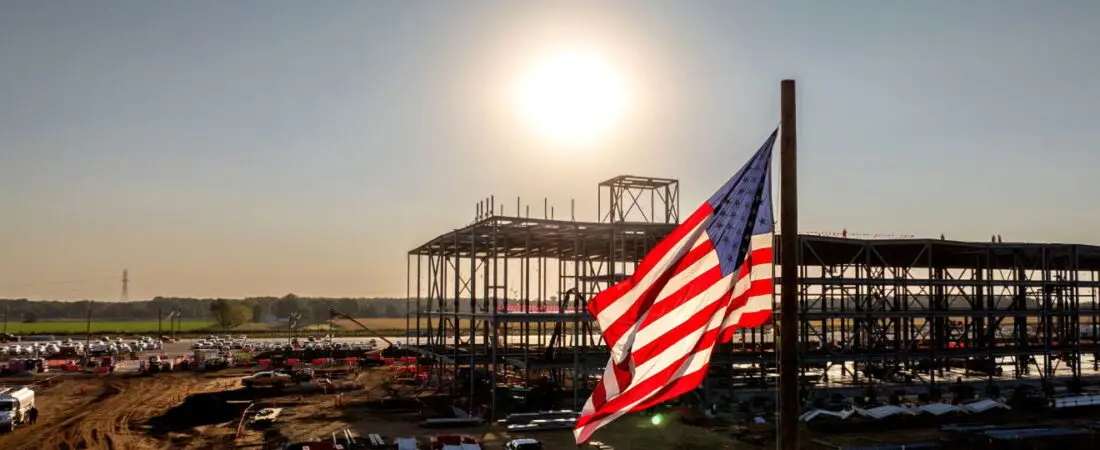
Amazon is adding another $6 billion to its planned data center development in northwest Louisiana, increasing its total commitment in the region to $18 billion and adding a third campus in Shreveport. The Amazon Louisiana data center expansion comes less than six months after the company announced its initial $12 billion investment and provides another indication of how quickly hyperscale infrastructure requirements are translating into large, multi-campus developments.
The third campus is planned for Resilient Technology Park in Shreveport. Amazon will continue working with STACK Infrastructure on construction and development of the facilities, which are intended to support Amazon Web Services cloud computing and AI infrastructure.
Executive Summary
Amazon announced the additional $6 billion investment on August 18, taking its planned northwest Louisiana data center investment to $18 billion across three campuses in Caddo and Bossier parishes.
Louisiana Economic Development says the expansion is expected to create 210 additional direct jobs and estimates another 499 indirect positions. Across all three campuses, Amazon expects to support up to 750 direct jobs.
The infrastructure commitments surrounding those facilities are particularly significant. Amazon says it is working with Southwestern Electric Power Company, or SWEPCO, to fully fund the new energy infrastructure and grid upgrades required for its data centers. The company also plans to invest up to $400 million in public water infrastructure supporting the three campuses.
Amazon Adds A Third Louisiana Data Center Campus
Amazon originally announced a $12 billion northwest Louisiana investment in February 2026. The addition of another $6 billion only months later extends that development to a third data center campus.
STACK Infrastructure will continue as Amazon’s development partner. STACK expects construction across the project to support up to 2,250 jobs, creating demand for contractors, electricians, skilled trades, engineering specialists, and other suppliers.
Amazon also plans workforce-development programs with educational institutions, technical colleges, and community organizations. The company identifies electricians, HVAC technicians, project engineers, network specialists, operations managers, and security specialists among the roles that could be supported by the development.
For northwest Louisiana, the significance goes beyond the headline capital expenditure. A three-campus development creates a longer-term requirement for technical labor, utility infrastructure, construction capacity, networking, maintenance, and supporting services.
Power Infrastructure Is Central To The Expansion
The electricity arrangements deserve particular attention because power costs have become one of the most contentious issues surrounding large data center developments in the United States.
Amazon says it is working with SWEPCO to fully fund the energy infrastructure and grid upgrades required to serve its Louisiana facilities. The stated objective is to prevent those project-specific costs from being transferred to existing electricity customers.
This reflects a wider shift in hyperscale development.
For years, site-selection decisions concentrated heavily on electricity prices, fiber availability, land, tax incentives, and proximity to customers. Those factors remain important, but enormous AI and cloud loads mean developers increasingly have to demonstrate how new generation, transmission, substations, and other utility infrastructure will actually be financed.
In other words, access to power is no longer sufficient. The commercial structure behind that power matters as well.
Water Infrastructure Is Becoming Part Of The Deal
Amazon is also committing substantial capital to water infrastructure. Louisiana Economic Development says the company plans to invest up to $400 million in public water infrastructure supporting the three campuses.
The company says its northwest Louisiana facilities will use air cooling for most of the year and rely on water for cooling when temperatures rise above approximately 85 degrees Fahrenheit. Amazon estimates those conditions will occur during less than 13% of the year.
Amazon says it will fund the water and wastewater improvements required by its projects while also working on programs intended to return more water to local watersheds than its operations consume.
The approach illustrates how cooling architecture is becoming a site-selection issue rather than simply a mechanical-engineering decision made after a location has been chosen.
A site may offer attractive land and electricity, but limited water availability or expensive utility upgrades can change the economics. Conversely, reducing dependence on water can increase the number of locations technically suitable for large-scale computing infrastructure.
Why Louisiana Is Attracting Data Center Investment
Amazon’s expansion is part of a much larger wave of digital infrastructure development in Louisiana.
The state is positioning itself as a location for AI and hyperscale infrastructure, supported by large development sites, energy resources, economic incentives, and an expanding pipeline of major projects.
Louisiana Economic Development says announced data center investment in the state now exceeds $81.6 billion. Other major projects include developments associated with Meta, Hut 8, and Applied Digital.
That concentration creates opportunities, but it also increases the importance of infrastructure planning. Multiple large-load customers competing for generation, transmission equipment, construction labor, transformers, water infrastructure, and suitable land can create constraints even in regions initially selected because they appeared to offer abundant resources.
The competitive advantage of an emerging data center market therefore depends on more than attracting the first hyperscaler. The harder task is ensuring infrastructure can scale when additional projects arrive.
The Ratepayer Question Is Reshaping Development
Louisiana has already responded to concerns about the effect of large data center loads on existing customers.
Governor Jeff Landry established the Louisiana Ratepayer and Community Protection Initiative in June, creating a framework for large-scale data center development and projects seeking the state’s Data Center Sales and Use Tax Exemption.
Amazon’s emphasis on paying for its own required electricity infrastructure fits directly into that political environment.
The development model matters to data center executives because community acceptance increasingly depends on whether operators can demonstrate that a project will generate investment and employment without transferring disproportionate infrastructure costs to households and existing businesses.
That calculation is becoming part of development risk.
What The Expansion Means For Data Center Operators
The Amazon Louisiana data center expansion illustrates how hyperscale projects are evolving from individual facilities into integrated infrastructure programs.
The investment is not limited to server buildings. It requires utility upgrades, water systems, workforce development, construction capacity, local suppliers, and long-term coordination between the operator, developer, utility, and government.
For infrastructure leaders planning their own capacity strategies, there is a useful lesson here. The availability of land does not establish that a site is ready for a large computing deployment. Neither does a theoretical utility allocation.
Developers increasingly need credible answers to several questions at the beginning of the project: Who funds the grid connection? Is transmission available? What water infrastructure is required? Can sufficient skilled labor be recruited? How quickly can utilities expand? And will local communities accept the resulting development?
Those questions can determine deployment schedules just as decisively as server procurement.
What Happens Next
Amazon and STACK will now advance the three-campus program while the associated energy, water, workforce, and community investments develop alongside it.
The third Shreveport campus will also test how quickly northwest Louisiana can absorb another major hyperscale development after attracting a succession of large AI and cloud infrastructure projects.
For the broader industry, Amazon’s decision to increase its commitment from $12 billion to $18 billion within months demonstrates that hyperscale capacity planning is moving rapidly. But the more important detail may be how the expansion is structured.
Power and water infrastructure are no longer peripheral negotiations around the data center. They are becoming part of the core investment proposition.
Conclusion
Amazon’s additional $6 billion commitment turns an already substantial Louisiana development into an $18 billion, three-campus program.
The scale is significant, but the infrastructure commitments surrounding it deserve equal attention. Amazon is pairing data center construction with energy-grid investment, public water infrastructure, workforce programs, and a commitment to cover project-specific utility costs.
That is increasingly what hyperscale development requires. For operators pursuing the next generation of AI and cloud capacity, securing a parcel and ordering servers is only the beginning. The successful sites will be those where power, water, labor, community support, financing, and construction can all scale together.