
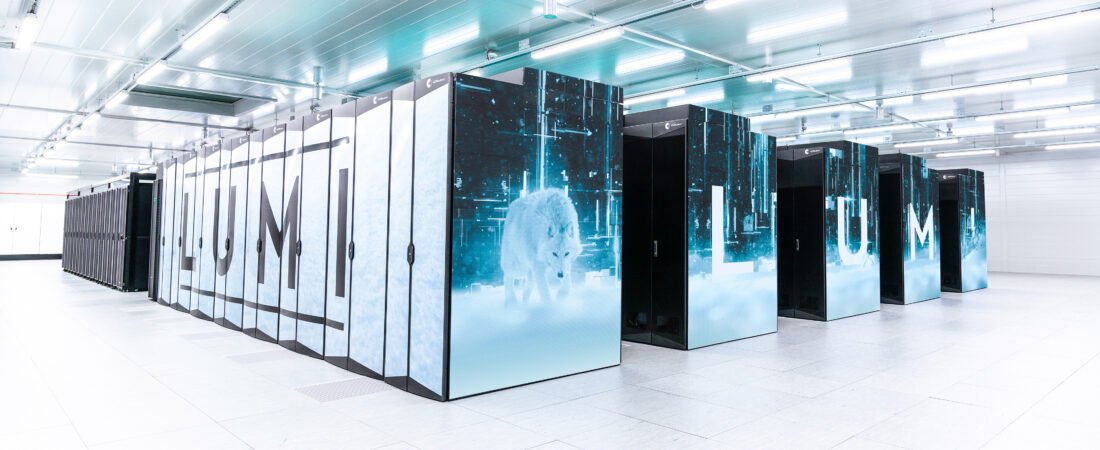
LUMI-AI Supercomputer: Europe Signs €387.8M Contract
Europe has signed a €387.8 million procurement contract for the LUMI-AI supercomputer, a new AI-optimized system that will be installed at CSC’s data center in Kajaani, Finland. The LUMI-AI supercomputer will use next-generation AMD Instinct MI430X GPUs and sixth-generation AMD EPYC 256-core processors, giving European researchers, startups, and industry substantially more infrastructure for AI training, inference, and high-performance computing.
The European High-Performance Computing Joint Undertaking, or EuroHPC JU, announced the contract with French technology company Bull on August 31. The system is expected to become available during 2027 and will serve as the computing backbone of the LUMI AI Factory.
Key LUMI-AI Supercomputer Facts
| Project detail | Reported specification |
|---|---|
| Contract value | €387.8 million |
| Installation location | CSC data center, Kajaani, Finland |
| Accelerators | AMD Instinct MI430X GPUs |
| Processors | Sixth-generation AMD EPYC 256-core CPUs |
| Expected availability | During 2027 |
| Facility strategy | Renewable electricity, liquid cooling, and heat reuse |
Why the LUMI-AI Investment Matters
- Europe gains substantially more regional capacity for AI training, inference, and scientific computing.
- AMD secures a major deployment for its next-generation Instinct and EPYC platforms.
- Liquid cooling, renewable power, heat reuse, and high-speed networking become integral parts of the compute architecture.
- The project strengthens Europe’s wider sovereign AI and AI Factory strategy.
Readers can follow Data Center Insider’s wider coverage of AI infrastructure, data center development, and advanced cooling systems.
What EuroHPC Has Announced
EuroHPC says the new system is expected to deliver approximately ten times the AI capacity of the existing LUMI supercomputer. AMD separately says LUMI-AI should provide nearly twice the high-performance computing capability of the current system.
The €387.8 million budget covers acquisition, delivery, installation, and maintenance. EuroHPC JU will provide half of the funding through the Digital Europe Programme, while the LUMI AI Factory consortium will fund the remaining 50%.
The consortium includes Finland, Czechia, Denmark, Estonia, Norway, and Poland.
AMD Wins A Major European AI Infrastructure Deployment
The hardware selection is significant because LUMI-AI represents another major production deployment for AMD’s accelerating AI infrastructure portfolio.
The system will combine Instinct MI430X accelerators with sixth-generation EPYC processors in an architecture intended to support both AI and conventional scientific computing.
For data center operators, this reflects a broader shift toward heterogeneous infrastructure. Large AI systems increasingly combine accelerators, CPUs, specialized networking, high-performance storage, and software orchestration rather than treating the GPU as an isolated component.
LUMI-AI Extends Europe’s AI Factory Strategy
LUMI-AI is part of EuroHPC’s wider AI Factory program, which is intended to give European startups, small and medium-sized businesses, researchers, and industry access to advanced computing infrastructure.
EuroHPC currently oversees 19 AI Factory sites across Europe, alongside additional AI Factory Antennas intended to broaden access to computing resources and expertise.
The strategic objective is clear: Europe wants more of the infrastructure required to train and deploy advanced AI systems located within its own research and industrial ecosystem.
That makes LUMI-AI both a computing investment and a sovereignty project.
The Data Center Infrastructure Matters Too
AMD says LUMI-AI will be deployed during the second half of 2027 at CSC’s new data center in Kajaani’s Renforsin Ranta business park.
The system is expected to operate on 100% renewable electricity and use liquid cooling, with excess heat captured for reuse through Kajaani’s district heating network.
That combination demonstrates how AI supercomputing increasingly affects the facility surrounding the processors. Dense accelerator infrastructure requires power, liquid cooling, high-performance networking, storage, and heat-rejection systems designed as one architecture.
Networking Will Be Critical
CSC has already been preparing its wider connectivity environment for the next generation of European AI infrastructure.
In earlier testing with SURF and Nokia, CSC demonstrated 1.2Tbps long-distance data transfers intended to prepare European research networks for LUMI-AI and other AI Factory workloads.
This matters because a large supercomputer is only as useful as its ability to ingest datasets, exchange research information, and connect efficiently to users across Europe.
What Happens Next
Bull will now move into delivery and installation, with LUMI-AI expected to become available to users in 2027.
The system will support AI training and inference, data-intensive scientific applications, and large-scale simulation. It will also integrate with the planned LUMI-IQ quantum computing platform.
For data center and infrastructure leaders, the project is another reminder that sovereign AI ambitions eventually become physical infrastructure requirements. Compute policy translates into GPUs, CPUs, storage, fiber, cooling, power, and buildings.
Conclusion
The €387.8 million LUMI-AI contract gives Europe a major new AI infrastructure platform and strengthens AMD’s position in high-end accelerated computing.
But the broader significance extends beyond processor selection. Europe is building an interconnected AI Factory ecosystem designed to give regional researchers and businesses access to large-scale compute while retaining greater control over where that infrastructure operates.
In the AI infrastructure race, sovereignty increasingly depends on owning more than models and software. It depends on having the physical computing capacity to run them.
LUMI-AI Supercomputer FAQ
What is the LUMI-AI supercomputer?
LUMI-AI is a planned European AI and high-performance computing system that will support model training, inference, scientific applications, and large-scale simulation.
Where will LUMI-AI be installed?
The system is expected to be installed at CSC’s new data center in the Renforsin Ranta business park in Kajaani, Finland.
When will LUMI-AI become available?
EuroHPC expects the system to become available to users during 2027, subject to delivery, installation, commissioning, and infrastructure readiness.
Which processors will LUMI-AI use?
The planned architecture combines AMD Instinct MI430X accelerators with sixth-generation AMD EPYC 256-core processors.