
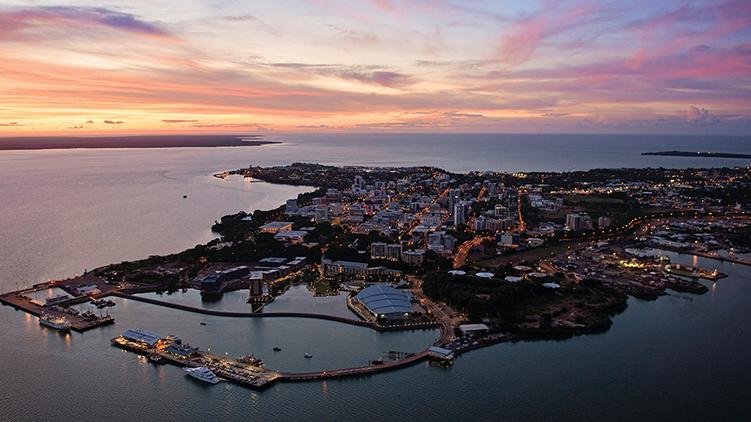
Australia AI Data Center Power: Darwin’s 2GW Bet
Australia AI data center power strategy is entering a new phase in the Northern Territory, where developers are considering whether large-scale generation should be built beside the compute rather than waiting years for conventional grid connections. Proposals around Darwin would combine local gas resources, renewable energy, storage, and hyperscale computing infrastructure in an attempt to turn speed-to-power into a regional advantage.
Reuters reported on September 3 that Northern Territory gas producers and advisers are promoting the region as an alternative to Australia’s more constrained southeastern data center markets. The attraction is straightforward: developers could build dedicated generation alongside new campuses instead of competing for scarce grid capacity and waiting for major transmission upgrades.
The approach is still unproven at the proposed scale. It could shorten the path to power, but it does not eliminate the need for renewable generation, environmental approvals, financing, fiber, cooling, equipment, skilled labor, and long-term customer commitments. For data center leaders, Darwin is therefore best viewed as a test of integrated infrastructure planning rather than a guaranteed new hyperscale hub.
A 2GW Darwin AI Data Center Project Is Being Advanced
Beetaloo Digital, a subsidiary of Beetaloo Energy, is progressing one of the largest proposals. The Northern Territory government granted the company a 12-month exclusive commitment—described publicly as a “do-not-deal” arrangement—over approximately 185 hectares at Weddell, around 30 kilometers south of Darwin.
The proposal could include up to 2GW of onsite gas-fired generation supporting hyperscale AI, cloud, and high-performance computing infrastructure. The Northern Territory government has said the development could attract as much as A$40 billion of private investment if fully realized. Those figures describe a potential buildout, not funded construction or commissioned capacity.
Beetaloo Digital describes the wider concept as an integrated energy hub combining gas-fired power, renewable generation, storage, and digital infrastructure. The company has also entered an early-stage, non-binding arrangement with Halliburton intended to support technical planning for gas development, power generation, and the proposed data center ecosystem.
Key Facts About the Weddell Proposal
| Item | Current position |
|---|---|
| Location | Weddell, approximately 30 kilometers south of Darwin |
| Land | Approximately 185 hectares under a 12-month exclusive commitment |
| Potential power | Up to 2GW of onsite generation |
| Potential investment | Up to A$40 billion if fully developed |
| Target workloads | AI, cloud, hyperscale, and high-performance computing |
| Status | Early-stage proposal requiring studies, approvals, capital, partners, and customers |
The Strategy Targets Australia’s Grid-Queue Problem
The project illustrates how access to electricity is changing data center site selection. Developers in established markets can secure land and prospective customers while still facing years of uncertainty around substations, transmission upgrades, and utility interconnection. In that environment, a site without a credible power schedule may have limited value regardless of its location.
Building generation beside a data center could change the timetable. Instead of asking when the grid can supply several hundred megawatts, a developer can evaluate whether fuel, generators, renewables, batteries, cooling, and network infrastructure can be assembled directly at the site. This mirrors the growing interest in data center microgrids and onsite power architectures across other capacity-constrained markets.
The model also creates new responsibilities. A conventional grid connection transfers much of the generation and balancing challenge to the electricity system. An integrated campus must coordinate generation availability, reserve capacity, storage duration, maintenance, fuel supply, emissions, and power quality with the operating profile of AI clusters. Reliability must be engineered across the complete energy system.
Gas Alone Will Not Satisfy Australia’s Emerging Rules
The strategy faces an important policy constraint. Australia’s federal government has said new data centers will need to be matched primarily with newly built renewable energy, with gas permitted as a supporting or backup resource rather than the sole long-term energy source.
That means Northern Territory proposals cannot simply rely on abundant shale gas and ignore renewable integration. Beetaloo Digital says its concept includes renewable energy and storage alongside gas generation, but the final mix, emissions profile, regulatory pathway, and construction program have not been established.
The design challenge is significant. Variable renewable output must be balanced against the continuous load profile expected from high-utilization AI infrastructure. Gas generation can provide firming, while batteries can manage short-duration fluctuations and support power quality. However, developers will need to show how the system meets policy requirements while remaining reliable and commercially competitive.
The Weddell Project Remains at an Early Stage
The scale of the proposal should not be confused with operating capacity. Beetaloo Energy has emphasized that development remains at an early stage. It requires concept and feasibility work, environmental and planning approvals, financing, infrastructure partners, equipment procurement, and anchor customers before construction can proceed.
That qualification matters because multi-gigawatt AI announcements increasingly attract attention long before projects are ready to build. The industry has already seen how large electricity requests can overstate near-term demand. As our analysis of data center “ghost demand” and grid queues explains, regulators and utilities are asking developers for stronger proof of project maturity.
A credible gas resource creates an opportunity, but it is only one part of the delivery chain. A fully bankable campus would still require:
- Customers willing to make long-term capacity commitments;
- Finance for generation, buildings, cooling, networks, and compute;
- Environmental, land-use, water, and emissions approvals;
- Firm plans for renewable energy and storage;
- Redundant fiber routes and international connectivity;
- A workforce capable of constructing, operating, and maintaining the campus; and
- Supply agreements for long-lead electrical and mechanical equipment.
Why Darwin Could Appeal to AI Developers
Darwin offers more than energy potential. Its location places it closer to major Asia-Pacific markets than Australia’s southeastern capitals, and the city is connected to international subsea cable systems. Beetaloo Digital positions the region as a possible bridge between Australian energy resources and growing Asian demand for AI and high-performance computing.
Data sovereignty could also support demand. Governments and enterprises increasingly want sensitive workloads hosted within defined jurisdictions, while global cloud providers seek geographically diverse capacity. A northern Australian location could complement—not necessarily replace—existing facilities in Sydney, Melbourne, and other established markets.
Australia already has substantial data center experience, illustrated by NEXTDC’s expanding contracted pipeline. Our coverage of the NEXTDC FY26 results shows how committed capacity is driving billions of dollars of construction. Darwin’s proposition is different: it is attempting to create an integrated power-and-compute market outside the country’s traditional hubs.
Remote Development Changes the Constraints
Moving away from congested data center hubs does not remove infrastructure constraints. It changes which constraints matter most. Darwin’s distance from established supply chains may raise the cost and complexity of importing transformers, generators, cooling equipment, server systems, and construction materials.
Workforce availability is another consideration. A multi-phase campus requires civil, electrical, mechanical, network, security, and operations specialists. Developers may need training programs, fly-in labor during construction, and long-term arrangements to build a stable local operations team.
Climate influences the design as well. Darwin’s tropical heat and humidity can increase cooling demands and limit opportunities for air-side economization. High-density AI halls are likely to depend on liquid cooling, efficient heat rejection, carefully managed water use, and equipment designed for the local environment.
Connectivity must be resilient rather than merely available. International cables provide strategic reach, but a hyperscale campus needs diverse terrestrial and subsea paths, carrier competition, low-latency links, and credible restoration plans. Power independence cannot compensate for a network single point of failure.
What Data Center Executives Should Watch
The Northern Territory experiment will become more credible as it converts broad ambition into measurable milestones. Executives assessing the opportunity should watch for five developments:
- Site control: whether the temporary exclusive land commitment becomes a definitive development agreement.
- Energy design: the proposed split between renewables, storage, gas generation, and any grid connection.
- Approvals: progress on environmental, planning, water, pipeline, and power-generation permissions.
- Commercial backing: binding participation from technology, infrastructure, finance, and customer partners.
- Delivery sequencing: a phased plan that matches generation, network, cooling, and data hall availability.
These milestones will show whether the proposal is moving from site promotion to an executable infrastructure program. They will also help the market judge whether the potential 2GW scale represents a realistic long-term buildout or an upper boundary for development.
Frequently Asked Questions
What is the Australia AI data center power proposal near Darwin?
Beetaloo Digital is examining an integrated energy and data center precinct at Weddell, south of Darwin. The early-stage concept could support hyperscale AI, cloud, and high-performance computing with as much as 2GW of onsite generation alongside renewable energy and storage.
Is the 2GW Darwin data center already under construction?
No. The figure describes the proposal’s potential scale. The project still needs detailed studies, approvals, financing, infrastructure partnerships, equipment, and customer commitments before construction and commissioning.
Why build power beside an AI data center?
Onsite generation can potentially reduce dependence on long utility interconnection schedules. It may give developers greater control over delivery, but it also makes them responsible for coordinating fuel, generation, renewables, storage, reliability, and emissions compliance.
Will the campus run only on natural gas?
The developer describes a broader mix that includes renewables and storage. Australian policy is also moving toward requiring new data centers to be matched mainly with new renewable generation, with gas serving a supporting or backup role.
Conclusion: Power Strategy Is Becoming Site Strategy
Australia’s Northern Territory is trying to turn an energy advantage into a data center advantage. If developers can combine onsite generation, new renewables, storage, cooling, and international fiber into a bankable commercial model, regions outside the traditional data center map could become significant AI infrastructure markets.
The larger lesson extends beyond Darwin. Power is no longer simply a utility service purchased after a site is selected. For the largest AI projects, generation technology, fuel access, grid policy, and delivery schedules increasingly determine where compute can be built.
Weddell remains a proposal, and its scale should be treated accordingly. Yet the question it raises is already urgent: should compute keep waiting for the grid, or should power and compute increasingly be developed as one coordinated system? For gigawatt-scale AI campuses, the answer may shape the next generation of data center geography.