
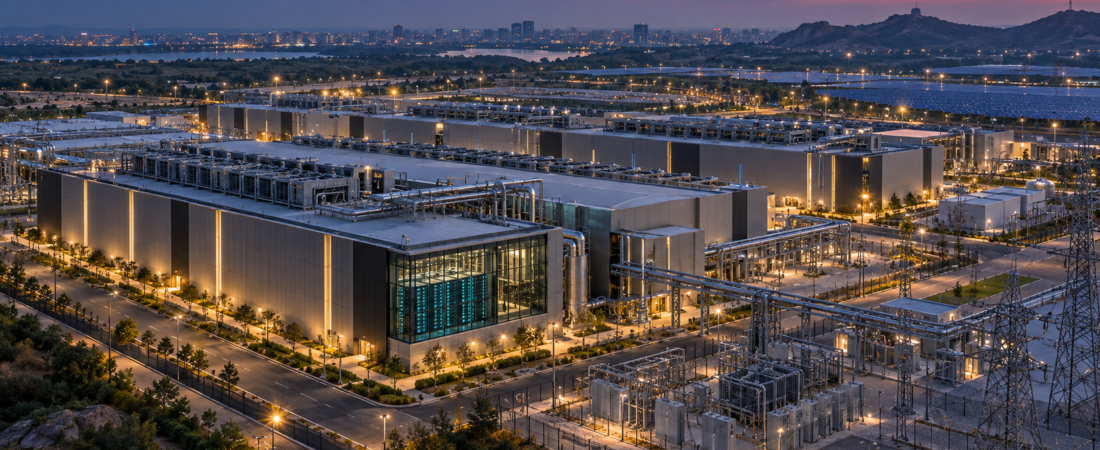
The TCS HyperVault Hyderabad data center is set to become one of India’s largest purpose-built AI infrastructure developments. TCS subsidiary HyperVault has secured 264 acres in Hyderabad for a phased campus with planned capacity of up to 1GW and investment of as much as ₹70,000 crore, approximately $7.4 billion.
Announced on September 5, 2026, the project is designed for hyperscalers and frontier AI companies that require high-density GPU infrastructure for AI training, inference, and advanced computing. HyperVault and its partners are expected to fund the development, while construction will proceed in phases according to customer demand and changing technology requirements.
The scale is significant, but the central infrastructure story is the proposed combination of direct-to-chip liquid cooling, larger power blocks, green energy, and high-density computing. Together, these systems illustrate how AI is reshaping the design of modern data center campuses.
TCS HyperVault Hyderabad Data Center Secures 264 Acres
According to the official TCS announcement, HyperVault has secured 264 acres of land in Hyderabad for the development. At full build-out, planned capacity could reach 1GW.
The company has not said that the entire gigawatt will be constructed immediately. Development will occur in phases, reflecting customer commitments and evolving technology requirements. That distinction matters because gigawatt-scale campuses increasingly represent long-term development envelopes rather than capacity that will arrive at once.
HyperVault says the campus will support hyperscalers and frontier AI companies deploying high-density GPU systems for training, inference, and other advanced workloads. The land allocation gives the company room to organize multiple data halls, power infrastructure, cooling systems, network routes, and supporting facilities across a large campus.
Investment Could Reach ₹70,000 Crore
HyperVault and its partners are expected to invest up to ₹70,000 crore in developing and managing the infrastructure. That equals ₹700 billion and was valued by Reuters at approximately $7.41 billion using the exchange rate cited in its September 5 report.
The investment ceiling should not be interpreted as immediate spending. Capital will likely follow construction phases, customer demand, equipment procurement, and the timetable for delivering power to the site. Even so, the figure demonstrates how AI infrastructure investment now extends far beyond servers and accelerators.
A campus of this size requires land preparation, substations, switchgear, backup systems, cooling plants, water infrastructure, fiber connectivity, security, and long-duration energy arrangements. At 1GW, power strategy becomes a central development program rather than a supporting facility decision.
A Campus Designed Around High-Density AI
TCS describes HyperVault as a purpose-built AI infrastructure platform rather than a conventional enterprise data center business. The Hyderabad campus is expected to use direct-to-chip liquid cooling, high rack densities, and an energy model combining green power with operational reliability.
HyperVault CEO Deepesh Kiran Nanda said the company is designing for higher density, liquid cooling, larger power blocks, and faster deployment. Those requirements increasingly have to be engineered together.
A higher-density GPU rack changes more than cooling demand. It can affect busway capacity, power conversion, backup requirements, switchgear sizing, rack architecture, coolant distribution units, and the utility interface. These dependencies make coordinated facility design essential for the TCS HyperVault Hyderabad data center.
Liquid Cooling Will Support Dense GPU Infrastructure
Direct-to-chip liquid cooling transfers heat from processors into a liquid loop close to the source. For high-density AI systems, this can provide a more practical path than relying only on air cooling as rack power rises.
However, liquid cooling is not a single component. Operators must coordinate facility water systems, secondary cooling loops, coolant distribution units, manifolds, controls, leak detection, heat exchangers, and maintenance procedures. The efficiency of the overall thermal chain will influence both operating costs and the amount of computing capacity the campus can support.
HyperVault’s stated focus on water-neutral design will also require careful measurement. The final outcome will depend on cooling architecture, local climate, water sources, heat-rejection systems, and the operating conditions selected for each phase.
Power Availability Will Be the Critical Test
The planned scale raises the same question facing almost every major AI campus: how quickly can reliable electricity be delivered? The TCS HyperVault Hyderabad data center could ultimately require power comparable to a large industrial complex.
TCS says the project will incorporate green energy, but it has not yet publicly detailed the complete generation mix, grid-connection timetable, backup architecture, or phased energization schedule. Those details will determine how quickly land can be converted into usable computing capacity.
Large-load developers increasingly combine utility supply with renewable power contracts, energy storage, and onsite backup or generation. Readers can follow related developments in Data Center Insider’s data center power coverage.
Hyderabad Strengthens India’s AI Infrastructure Base
The project reflects India’s push to expand domestic AI compute capacity. TCS launched HyperVault as a dedicated AI infrastructure business backed by the wider Tata ecosystem and strategic investment from TPG. The business is being developed toward more than 1GW of capacity in India.
For customers, domestic hyperscale infrastructure can reduce dependence on overseas compute while improving access to locally hosted training and inference capacity. Hyderabad also offers a large technology workforce and an established digital-services ecosystem.
Yet campus scale alone will not guarantee success. HyperVault will need to coordinate power, cooling, equipment supply, networking, construction labor, permits, and customer commitments while maintaining a competitive deployment schedule.
What Happens Next
The immediate milestones will include phased construction, power procurement, utility interconnection, environmental approvals, customer commitments, and delivery of the first operational capacity. Equipment choices and density targets may also evolve as new GPU platforms reach the market.
Operators should therefore avoid treating the announced 1GW figure as near-term live capacity. TCS explicitly says development will follow customer demand and technology requirements. The first phase, its power allocation, and its expected service date will provide clearer evidence of the project’s delivery timetable.
Even with those qualifications, the direction is clear: AI infrastructure in India is moving toward the same campus-scale power and cooling architecture appearing in the world’s largest hyperscale markets.
Conclusion
The TCS HyperVault Hyderabad data center is significant not simply because of its potential $7.4 billion price tag, but because of what a 1GW AI campus demands from the surrounding infrastructure.
At that scale, power availability, direct liquid cooling, grid integration, network capacity, water strategy, and deployment speed become inseparable from the compute strategy itself.
For TCS, HyperVault also marks a deeper move from providing enterprise technology services into owning and operating the physical infrastructure on which future AI workloads will run. The project’s phased execution will now determine how quickly that ambition becomes operational capacity.