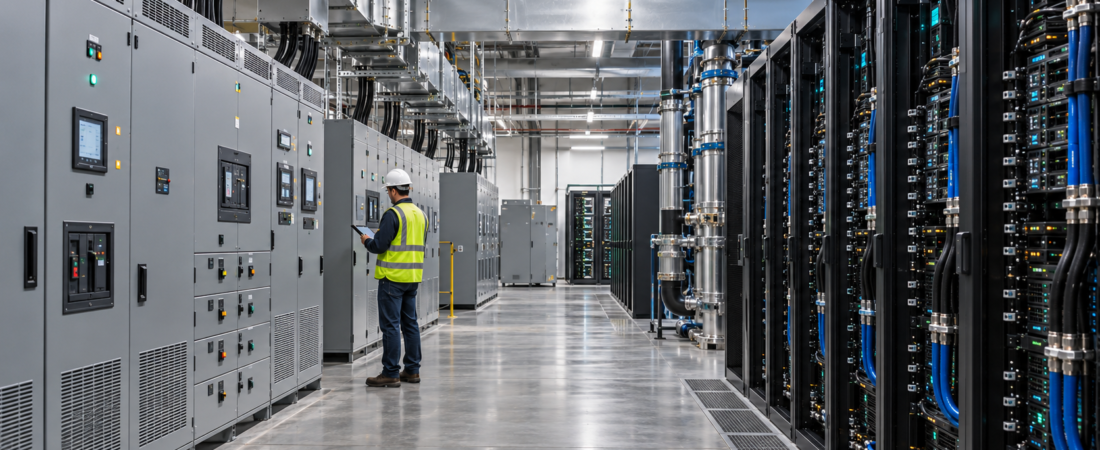
AI data center power quality is becoming a critical design issue because large GPU clusters do not consume electricity in the same way as traditional enterprise IT. The problem is not only how much power an AI facility needs, but how quickly that demand can change and how those changes interact with UPS systems, generators, transformers, switchgear, cooling equipment, and the utility grid.
A data center may have enough contracted megawatts and still encounter electrical instability if thousands of accelerators change load state rapidly. Large synchronized load swings can produce voltage disturbances, stress backup systems, increase harmonic distortion, and complicate recovery after faults or outages.
That means AI electrical design increasingly needs to address dynamic behavior rather than relying only on steady-state capacity calculations.
These risks grow as rack densities increase and campuses connect synchronized compute blocks to constrained regional utility networks worldwide.
Why AI Loads Behave Differently
Traditional enterprise servers usually create relatively diverse electrical demand across a large facility. Individual systems may become busier or quieter, but the overall load is often smoothed by thousands of unrelated applications.
Large AI clusters can behave differently.
Accelerators within the same training job may perform similar operations at the same time. They may move from intensive compute phases into communication, synchronization, checkpointing, or waiting states together.
When many GPUs change their power consumption simultaneously, the data center can experience a rapid step in electrical demand.
The larger the cluster, the larger the potential change.
Load Steps Can Create Voltage Disturbances
A load step occurs when electrical demand changes rapidly rather than gradually.
If a large AI cluster suddenly demands substantially more power, voltage on the local electrical system can temporarily fall. If demand drops quickly, voltage may rise.
The severity depends on system impedance, transformer capacity, UPS topology, distribution design, generator characteristics, and the speed of the change.
Small voltage variations are normal, but larger disturbances can affect sensitive equipment or create operational alarms.
At gigawatt-scale campuses, the utility may also care about how quickly a facility changes demand because those changes can affect the wider grid.
Harmonics Are Becoming More Important
Modern data centers contain large numbers of nonlinear electrical loads.
Servers, UPS systems, variable-frequency drives, power supplies, rectifiers, and other power-electronic devices do not always draw current in a perfect sinusoidal waveform.
This can introduce harmonics into the electrical system.
Harmonic distortion can increase heating in transformers and conductors, interfere with equipment, reduce usable system capacity, and contribute to nuisance operation of protection systems if it is not managed correctly.
ABB identifies harmonic distortion as an important data center power-quality issue, particularly where large numbers of electronic loads and drives are present.
Cooling Systems Add Their Own Electrical Effects
AI power quality is not only a server problem.
High-density liquid cooling introduces pumps, coolant distribution units, heat-rejection equipment, and other mechanical systems that frequently use variable-frequency drives.
Those drives improve control and energy efficiency, but they can also contribute harmonics and create power-factor or inrush-current considerations.
Vertiv has identified these characteristics as relevant when integrating liquid-cooling infrastructure into data center electrical systems.
As rack density rises, the cooling plant becomes increasingly tied to the behavior of the compute load.
UPS Systems Are Taking On A Larger Role
UPS systems have traditionally been designed primarily to maintain power during utility disturbances and bridge the interval before generators or other backup sources take over.
AI may expand that role.
Schneider Electric has argued that energy-storage systems can help smooth rapid AI load fluctuations, using batteries to absorb short-term differences between compute demand and available supply.
Instead of responding only when the grid fails, a UPS or battery system could support the facility during normal operation by reducing the size or rate of sudden load changes seen upstream.
This turns energy storage into a dynamic power-management resource.
Battery Energy Storage Can Buffer The Grid
Battery energy storage systems can provide a similar function at larger scale.
If AI demand rises quickly, batteries can temporarily supply part of the increase. If demand falls, the battery system may absorb energy or reduce discharge.
The objective is to present a smoother load profile to the utility or onsite generation system.
This can be valuable where grid operators impose ramp-rate limits or where the local network is electrically weak.
However, frequent cycling changes battery economics and degradation patterns, so operators need to model the cost of using storage for load smoothing as well as backup.
Generators May Struggle With Rapid AI Transitions
Backup generators introduce another challenge.
Engines and alternators do not respond instantaneously to large changes in electrical demand.
If a generator is carrying an AI load that increases suddenly, engine speed and frequency can temporarily fall before the control system supplies additional fuel and torque.
A rapid load reduction can create the opposite effect.
This is one reason generator sizing based only on maximum kilowatts can be inadequate.
Engine transient performance, spinning reserve, load-step capability, and interactions with UPS systems all need to be evaluated.
Fault Ride-Through Is Becoming More Important
Large AI campuses are also increasingly being asked to behave more like industrial power users.
Utilities may expect facilities to remain stable during short voltage or frequency disturbances rather than disconnecting immediately.
This capability is known as fault ride-through.
If thousands of megawatts of data center load were to disconnect from a grid at the same moment, the sudden demand reduction could itself create a system problem.
Eaton includes fault ride-through and post-fault recovery among the emerging grid-compliance considerations for large AI data centers.
Workload Scheduling Could Become A Power Tool
One of the most interesting opportunities is using software to manage electrical demand.
If operators know that certain AI jobs create sharp synchronized load changes, schedulers could potentially stagger workloads or adjust accelerator utilization to reduce the electrical impact.
This turns compute orchestration into part of the facility power-control strategy.
The concept is similar to demand response, but implemented at workload level.
Instead of always forcing the electrical infrastructure to absorb every change produced by the compute layer, software can help shape the load before it reaches the grid.
What Data Center Leaders Should Measure
- Magnitude and frequency of GPU load steps.
- Voltage sag and swell during major workload transitions.
- Total harmonic distortion at critical distribution points.
- Power factor across IT and mechanical loads.
- UPS response during rapid load changes.
- Battery cycling caused by load-smoothing functions.
- Generator transient response and allowable load steps.
- Frequency variation during islanded operation.
- Harmonic contribution from VFD-driven cooling equipment.
- Recovery behavior following voltage or frequency faults.
- Maximum permitted utility ramp rate.
- Time required for controlled workload restart.
- Correlation between GPU utilization and facility electrical events.
Power Quality Should Be Tested Before Full Deployment
AI electrical behavior should ideally be evaluated during commissioning rather than discovered after the facility reaches full utilization.
Testing can include simulated load steps, UPS transitions, generator operation, battery response, harmonic measurements, and recovery from utility disturbances.
Facilities should also test interactions between power and cooling systems.
A rapid change in compute load can alter both electrical and thermal demand, and those two systems may respond on different timescales.
Frequently Asked Questions
What Is AI Data Center Power Quality?
AI data center power quality refers to the stability and characteristics of the electricity serving high-density AI infrastructure, including voltage, frequency, harmonics, power factor, transient behavior, and response to rapid workload changes.
Why Do GPU Load Swings Matter?
Large groups of GPUs can change power consumption rapidly and sometimes simultaneously. Those changes can create voltage disturbances, stress UPS and generator systems, and affect the facility’s interaction with the utility grid.
Can Batteries Smooth AI Power Demand?
Yes. UPS batteries or larger battery energy storage systems can supply or absorb short-duration power to reduce the rate of change seen by generators or the grid. The economics depend on cycle frequency, battery chemistry, and system design.
Are Harmonics Caused Only By Servers?
No. Harmonics can also come from UPS systems, rectifiers, variable-frequency drives, pumps, cooling equipment, and other power-electronic loads throughout the facility.
Monitoring helps engineers identify risks before deployment, protecting availability upstream.
Conclusion
AI data center power quality is becoming a design problem in its own right.
The next generation of facilities cannot be engineered only by adding together rack power and calculating a peak megawatt requirement. Engineers also need to understand how quickly that demand changes, how the electrical system responds, and how those changes affect backup systems and the wider grid.
Voltage stability, harmonics, power factor, fault ride-through, generator dynamics, controlled restart, and battery-based load smoothing are therefore moving closer to the center of AI infrastructure planning.
The most advanced designs will likely coordinate power systems with workload orchestration rather than treating the two as independent domains.
For data center leaders, the key lesson is simple: securing enough electricity is only the first step. The facility must also be able to consume that electricity in a way that remains stable, predictable, and compatible with increasingly demanding grid requirements.