
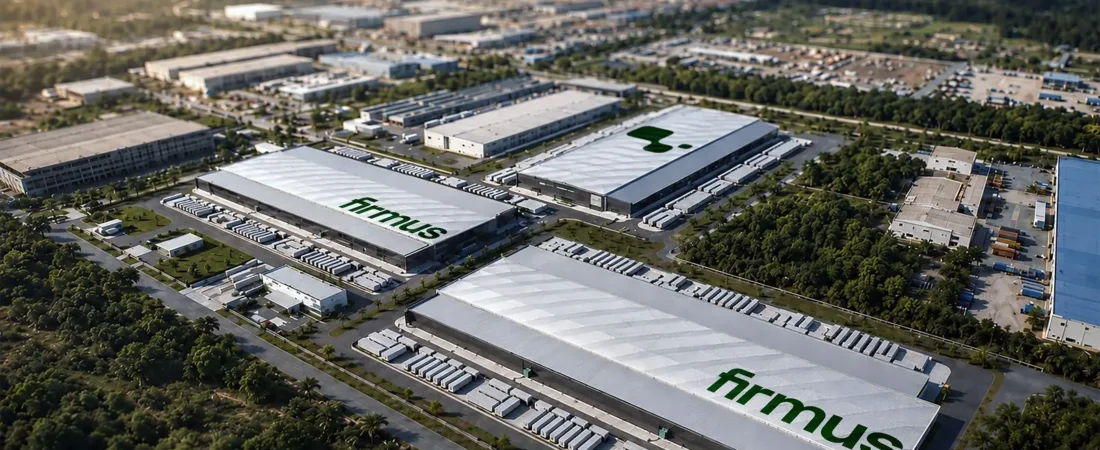
The Firmus OpenAI Malaysia agreement will provide dedicated AI compute capacity from two Malaysian data centers under a multi-year partnership, making OpenAI an anchor customer as the Australian infrastructure company expands across Asia-Pacific. The agreement takes Firmus’ total contracted customer capacity to more than 900MW.
The companies announced the partnership on September 8. According to the official Firmus announcement, the OpenAI capacity will be delivered from two AI Factory sites in Malaysia, extending a regional portfolio that now covers Australia, Singapore, Indonesia, and Malaysia.
The deal matters beyond another hyperscale customer announcement. It illustrates how AI infrastructure providers are increasingly securing customers before the physical capacity supporting those contracts is fully operational.
Firmus OpenAI Malaysia Agreement Lifts Contracted Capacity Above 900MW
Firmus says its contracted customer portfolio has passed 900MW following the OpenAI agreement.
That figure should not be confused with 900MW of operating data center capacity.
The company currently has seven AI Factory sites across four countries. Two are operational, in Australia and Singapore, while five are under development and targeting ready-for-service dates over the next 24 months.
Firmus did not disclose the specific megawatt commitment associated with OpenAI, nor did it disclose the financial value of the contract in its announcement.
OpenAI Will Use Two Malaysian Data Center Sites
The agreement gives OpenAI dedicated AI compute capacity from two Firmus sites in Malaysia.
Malaysia has rapidly developed into one of Southeast Asia’s most important data center markets as hyperscalers and AI infrastructure companies seek large sites, regional connectivity, and access to power.
That expansion is beginning to create infrastructure pressure.
Reuters reported on September 8 that data centers accounted for a record 9.3% of Peninsular Malaysia’s electricity consumption during a period of unusually high temperatures in mid-August, compared with an average of around 7% during 2026.
That does not mean Malaysia lacks the power to support further development. It does show why future AI projects will increasingly be judged on energization schedules and grid capacity rather than announced megawatts alone.
The Deal Extends Firmus’ Regional Expansion
Firmus has been building an increasingly broad Asia-Pacific infrastructure footprint.
The company says its platform now spans seven AI factories across Australia, Singapore, Indonesia, and Malaysia.
Its expansion strategy combines physical data center infrastructure with AI compute rather than positioning Firmus purely as a conventional colocation operator.
OpenAI becoming an anchor customer provides a substantial demand signal for that model, but the operational test will be whether Firmus can bring its development pipeline online according to schedule.
Contracted Capacity Is Not The Same As Operational Capacity
The distinction is increasingly important across the data center industry.
Developers routinely announce gigawatt-scale pipelines, customers reserve large blocks of future capacity, and operators sign contracts before substations, cooling plants, data halls, and compute infrastructure are fully commissioned.
Those agreements can provide the commercial certainty required to finance construction. But they should not be interpreted as evidence that the equivalent amount of compute is already available.
Firmus is unusually clear about that distinction: two of its seven sites are operational, while five remain under development.
Why The Malaysian Location Matters
For OpenAI, additional capacity in Malaysia adds geographic diversity to a rapidly expanding global AI infrastructure footprint.
For Malaysia, the agreement reinforces the country’s growing role as an AI infrastructure market rather than simply a regional cloud and colocation hub.
The trade-off is increasingly visible. AI investment brings construction, digital infrastructure, and potential economic activity, but it also creates large long-term demands on electricity systems.
Operators will therefore face greater scrutiny over how quickly projects become operational and how their power requirements are supplied.
What Happens Next
The key milestones are now physical rather than contractual.
Firmus is targeting ready-for-service dates for its five sites under development over the next 24 months. The company has not disclosed individual delivery dates for the two Malaysian facilities in its September 8 announcement.
Infrastructure leaders should watch the rate at which contracted megawatts translate into energized data halls, installed compute, and usable customer capacity.
Conclusion
The Firmus OpenAI Malaysia agreement gives Firmus one of the AI industry’s most prominent customers and takes its reported contracted portfolio beyond 900MW.
But it also illustrates a distinction becoming critical to understanding the AI data center market.
Demand can be contracted faster than infrastructure can be built.
For CIOs, investors, utilities, and data center operators, the increasingly useful metric is therefore not simply how many megawatts have been announced or reserved. It is how many have been energized, commissioned, equipped, and made available to run production workloads.