
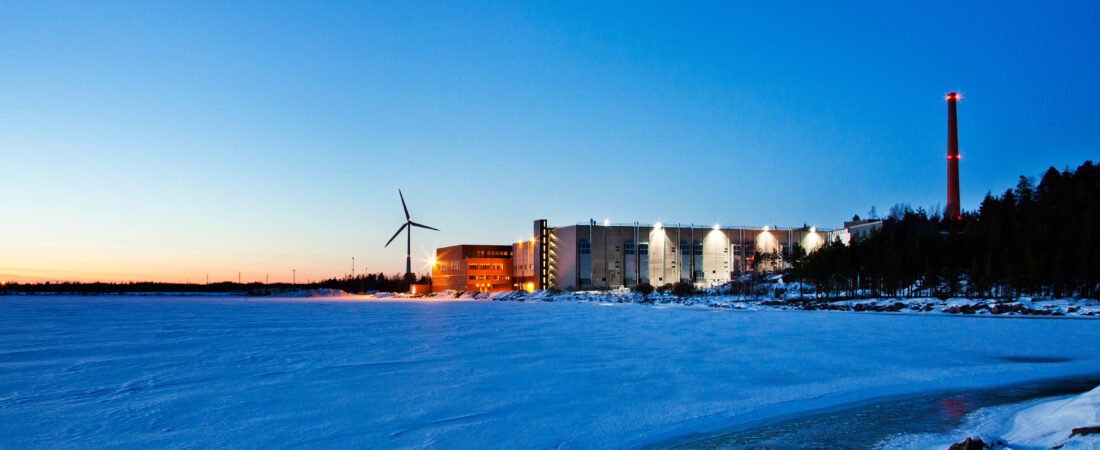
Google plans to invest €13 billion in Finland during 2027 and 2028 as it expands digital and AI infrastructure while committing additional capital to the energy systems required to support that growth. The Google Finland AI infrastructure program covers new data center development and supporting investments across Hamina, Kajaani, Muhos, and Vaala.
Announced September 9, the program is Google’s largest single investment commitment in Europe, according to the company. It combines physical digital infrastructure with nuclear power, additional wind generation, battery storage, grid coordination, and local workforce programs.
The scale matters because Google is not treating electricity procurement as a separate problem to be solved after the data centers are built. Energy availability is being designed into the infrastructure strategy from the beginning.
Google Will Invest €13 Billion Over Two Years
Google says the €13 billion commitment will be deployed during 2027 and 2028 across digital infrastructure, clean-energy projects, and economic partnerships in Finland.
The company already operates a major data center campus in Hamina, where it converted a former paper mill into a facility that uses seawater-based cooling.
The new program expands Google’s infrastructure presence beyond Hamina to Kajaani, Muhos, and Vaala.
Google has not disclosed the exact megawatt capacity of the new data centers in its September 9 announcement, so the investment figure should not be interpreted as a direct measure of new IT load.
A 22-Year Nuclear Agreement Underpins The Expansion
The most significant energy component is a new power purchase agreement with Finnish utility Fortum covering the Loviisa nuclear power plant.
Fortum says the 22-year agreement can cover up to 50% of the plant’s capacity. The PPA begins at a smaller level in 2028 and is scheduled to reach 50% of capacity during 2030–2049.
The agreement provides revenue certainty for Fortum’s planned life-extension investments, which are intended to keep Loviisa operating through 2050.
Fortum says the plant currently supplies about 10% of Finland’s electricity.
Wind And Battery Storage Add Flexibility
Google’s strategy does not rely on nuclear power alone.
The company says its contracted new-to-grid onshore wind portfolio in Finland will reach 629MW. It is also enabling a 94MW battery system near its Kajaani site, with operation expected in late 2027.
The battery is intended to help balance the Finnish electricity system and reduce price volatility during periods when wind generation is low.
Google also plans to explore demand response with grid operators, potentially allowing data center load to be reduced temporarily during periods of system stress.
Location Is Becoming An Energy Decision
One of the more important aspects of the announcement is how Google selected its expansion locations.
The company says it worked with Fingrid, Business Finland, and local municipalities to identify sites with existing grid infrastructure and access to carbon-free electricity.
That reflects a wider shift in hyperscale development.
For very large AI campuses, location can no longer be selected primarily on land availability and network connectivity. The ability of the surrounding power system to support additional load is becoming one of the first design constraints.
Why The Investment Matters
Google’s Finland expansion illustrates how cloud infrastructure and energy infrastructure are converging.
AI demand is increasing the amount of electricity hyperscalers need, while grid connection queues and generation constraints make traditional procurement strategies harder to scale.
Long-term nuclear contracts, renewable power purchase agreements, batteries, and demand response provide different functions. Nuclear offers continuous generation, wind adds renewable supply, batteries provide flexibility, and demand response can help manage periods of grid stress.
The significance is the portfolio rather than any single technology.
What Happens Next
The next milestones will be execution rather than announcements.
Google’s €13 billion program covers 2027 and 2028, while the 94MW battery is expected to begin operating in late 2027. Fortum’s nuclear agreement begins in 2028 and ramps toward its larger contracted share from 2030.
Infrastructure leaders should watch how quickly the announced investment translates into energized and commissioned data center capacity, and how effectively the combination of nuclear power, wind generation, storage, and demand response supports Google’s growing compute requirements.
Conclusion
The Google Finland AI infrastructure program is notable not simply because of its €13 billion scale, but because the data center and energy strategies are being developed together.
Google is combining new digital infrastructure with nuclear generation, additional wind supply, battery storage, and potential demand response.
That approach reflects a reality becoming difficult for hyperscalers to avoid: securing servers is no longer enough. Large AI deployments increasingly depend on securing the grid capacity, generation, and flexibility required to operate those servers for decades.
For data center leaders, Finland provides another example of how site selection, energy procurement, grid planning, and compute expansion are converging into a single infrastructure strategy.