
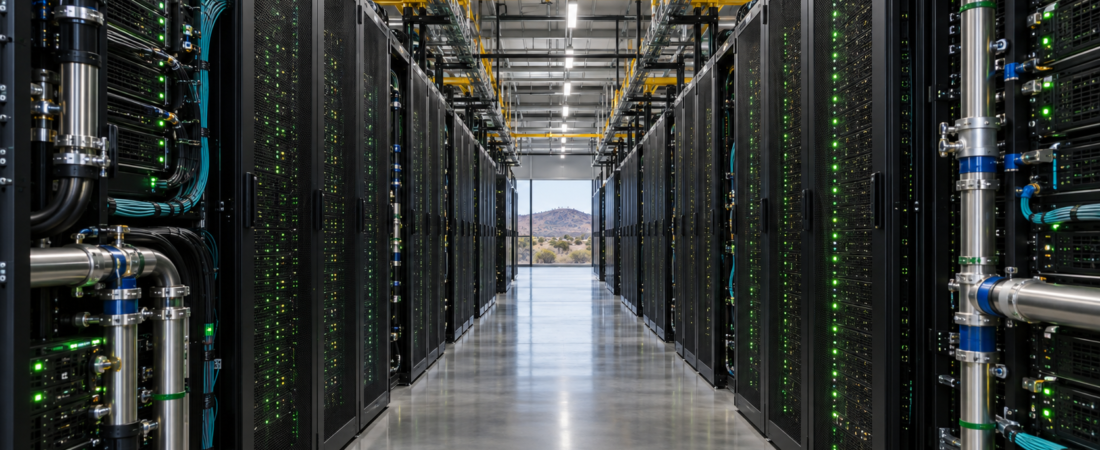
NVIDIA Australia AI data centers could add up to 2GW of new AI-related infrastructure by 2027 under a broad partnership involving some of the country’s largest cloud and data center operators.
NVIDIA announced the initiative on September 9, naming Firmus, Sharon AI, IREN, Megaport, ResetData, CDC, NEXTDC, and AirTrunk as partners. The participating companies will develop and operate the AI factories, while NVIDIA will provide its DSX platform, accelerated computing, networking, software, and ecosystem support.
The scale is significant. Reuters reported that Australia’s existing data center computing capacity is approximately 1.6GW, citing Data Centres Australia and DC Byte. A full 2GW buildout would therefore represent a major addition to the country’s installed infrastructure base.
NVIDIA Is Building An Ecosystem Rather Than One Campus
The announcement differs from a conventional hyperscale development because the proposed capacity is distributed across multiple operators and projects.
NVIDIA describes DSX as a full-stack AI factory platform covering facility infrastructure, computing, networking, software, and reference designs. The strategy is intended to allow operators to deploy several generations of NVIDIA infrastructure without treating every new accelerator cycle as a completely separate facility architecture.
That is important for data center owners facing faster hardware refresh cycles and sharply rising rack densities. It also reflects the way AI capacity is increasingly assembled: silicon, network fabrics, cooling, electrical systems, software, and operating processes must work as one platform.
Unlike a single-campus announcement, the initiative spreads delivery responsibility across operators with different sites, development schedules, customers, and energy arrangements. That may diversify execution risk, but it also makes the headline target more difficult to evaluate without project-level milestones.
Several Large Projects Are Already In The Pipeline
NVIDIA says IREN is applying the DSX architecture at its planned 800MW Bundey campus in South Australia.
Sharon AI, meanwhile, is planning deployments of up to 68,000 NVIDIA GPUs connected using Quantum InfiniBand and Spectrum-X Ethernet.
CDC says it already operates more than 550MW across Australia and New Zealand with another 800MW under construction. NEXTDC and AirTrunk are contributing high-density, liquid-cooled infrastructure designed for AI workloads.
These are company-reported figures and should not be interpreted as proof that the full 2GW is already commissioned. NVIDIA’s announcement describes a buildout target for 2027 rather than currently operational capacity. Readers should distinguish planned, contracted, under-construction, energized, and operational megawatts when comparing projects.
DSX Connects Facilities With Accelerated Computing
The DSX approach matters because an AI factory is not defined by GPUs alone. New accelerators can change rack power, coolant flow, floor loading, busway requirements, switching, cabling, and control systems. Reference architectures can give operators a common framework for coordinating those dependencies.
Standardization may also make future upgrades easier. Facilities designed around only one hardware generation can become difficult to adapt when power density and cooling requirements change. A platform spanning facility infrastructure and software aims to reduce that friction, although each operator must still adapt the design to local utilities, building constraints, and customer requirements.
The networking layer is equally important. Large clusters depend on predictable east-west traffic, low-latency fabrics, and resilient links between accelerators, storage, and supporting services. The wider Australian market will also require strong terrestrial and international connectivity as local AI capacity serves regional workloads.
Power Delivery Will Determine The Real Timeline
The central constraint is electricity.
Adding AI infrastructure at this scale requires more than acquiring GPUs and constructing buildings. Developers need substations, transmission capacity, cooling systems, backup power, network connectivity, and firm delivery schedules for electrical equipment.
NVIDIA itself says the expansion is intended to support additional power-generation projects alongside regional and global demand for AI compute.
That point matters because Australia’s AI ambitions are increasingly tied to the ability of its power system to support new high-density facilities without delaying deployment or shifting excessive infrastructure costs elsewhere.
A 2GW target should therefore be read as both a compute ambition and an energy-infrastructure program. Utilities and developers will need clear connection milestones, realistic ramp profiles, and credible plans for reliability. Announced renewable generation does not by itself guarantee that power is available at the required site, time, and quality.
Cooling And Network Design Must Scale With Power
Higher rack densities concentrate heat in a smaller footprint. Operators named in the initiative are therefore not simply adding conventional halls; they are preparing infrastructure for liquid-cooled AI systems. Cooling design must be coordinated with water strategy, heat rejection, redundancy, maintenance access, and the temperatures supported by each generation of equipment.
Network capacity must grow at the same time. NVIDIA’s Quantum InfiniBand and Spectrum-X Ethernet platforms address cluster fabrics, while partners such as Megaport contribute wider connectivity. The complete service still depends on resilient carrier access, cloud connections, storage traffic, and paths to users outside Australia.
These dependencies explain why multi-cloud AI infrastructure cannot be measured by accelerator counts alone. Usable capacity depends on the entire chain being commissioned and tested.
Why The Australian Market Matters
Australia combines large renewable-energy resources, established hyperscale markets, international subsea connectivity, and growing demand for sovereign and regional AI infrastructure.
The NVIDIA initiative also gives local enterprises, universities, startups, and developers greater potential access to advanced accelerated computing without relying entirely on capacity located overseas.
For operators, however, the commercial opportunity comes with execution risk. Announced capacity must still become energized, commissioned, and occupied capacity. The market will need enough customer demand to support staged deployments while avoiding speculative infrastructure that remains unused.
Domestic capacity may also improve workload locality for organizations with latency, resilience, or data-governance requirements. Those advantages depend on service availability, pricing, and the range of software and cloud options built on top of the underlying facilities.
Milestones Infrastructure Leaders Should Track
- Utility connection agreements and firm energization dates for each site.
- Substation, transmission, backup-power, and cooling-system completion.
- Installed accelerator numbers rather than headline pipeline commitments.
- Commissioned megawatts available for production customer workloads.
- Network fabric, storage, and external connectivity readiness.
- Customer occupancy, utilization, and deployment schedules during 2027.
These measures provide a clearer view than aggregating every announced project into one figure. They also help separate infrastructure that has land or planning approval from capacity that can reliably run production workloads.
What Happens Next
The most useful milestones will be project-specific rather than the headline 2GW figure.
Infrastructure leaders should watch individual site energization dates, utility agreements, cooling deployment, accelerator installation, and the amount of capacity that reaches production during 2027.
If NVIDIA and its partners deliver a substantial portion of the planned buildout, Australia would gain a much larger role in Asia-Pacific AI infrastructure. If power or construction schedules slip, the gap between announced and operating capacity will become just as important as the scale of the original commitment.
Frequently Asked Questions
How Much AI Data Center Capacity Is Planned?
NVIDIA says the partnership could support up to 2GW of new AI-related infrastructure in Australia by 2027. The figure is a buildout target and should not be treated as currently operational capacity.
Which Companies Are Involved?
The announced partners are Firmus, Sharon AI, IREN, Megaport, ResetData, CDC, NEXTDC, and AirTrunk. They contribute different combinations of development, operations, cloud services, high-density facilities, and connectivity.
What Is The Biggest Constraint?
Power delivery is the central constraint. Projects also require coordinated cooling, substations, transmission, backup systems, networks, equipment delivery, commissioning, and customer demand.
Is The Full 2GW Already Under Construction?
No. The announcement combines multiple partner projects and development stages. Evaluating progress requires site-level evidence of construction, energization, installed compute, commissioning, and production use.
Conclusion
NVIDIA’s Australian strategy shows how AI infrastructure development is becoming an ecosystem exercise involving chip vendors, data center operators, cloud providers, networking companies, and energy systems.
The 2GW target is substantial, but the more important test is execution.
For data center leaders, the story is not simply that Australia may gain more AI capacity. It is that the ability to coordinate land, power, liquid cooling, connectivity, and multiple generations of compute is becoming a competitive capability in its own right.