
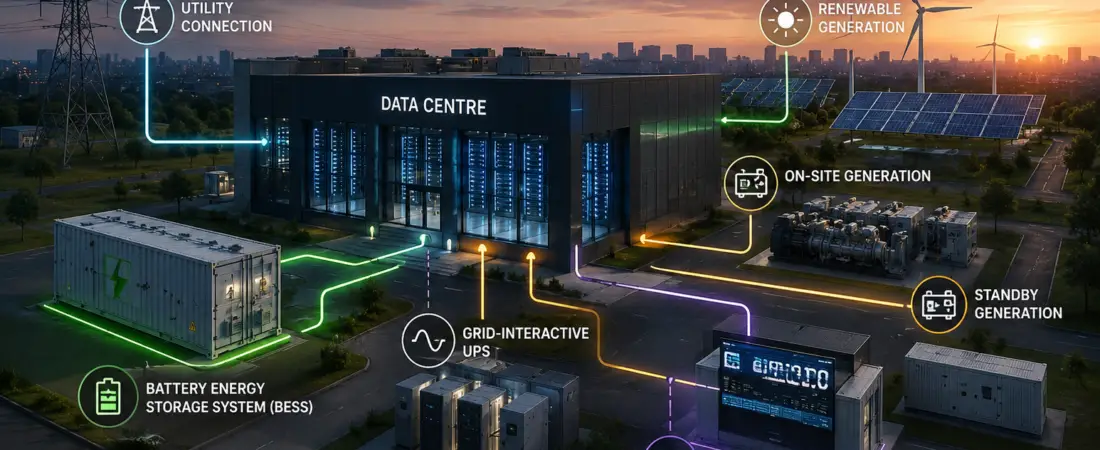
Data center microgrids are moving from a specialist resilience option to a serious design consideration for some high-density campuses. They bring utility power, local generation, storage and controllable loads under one operating strategy. That can improve resilience and make a constrained grid connection more usable, but only when protection, controls, commercial arrangements and mission-critical availability are engineered as one system.
Why AI Changes The Power Problem
Accelerated computing changes more than a data center’s annual electricity consumption. Large GPU clusters can concentrate demand into fewer racks, reduce the diversity between individual IT loads and create faster changes in power draw. Cooling auxiliaries may also increase or vary with the compute load. The result is a larger, more dynamic campus demand that must be supported through the utility connection, switchgear, transformers, UPS plant and cooling power chain.
Vertiv describes AI loads as high-density and comparatively dynamic, while its technical guidance says a correctly configured UPS can filter sharp load transitions before they propagate towards the mains or battery system. This is not evidence that every AI facility needs a microgrid. It does show why electrical behavior not merely megawatt-hours has become a capacity-planning issue.
At the same time, a development may be ready before the local transmission or distribution network can supply its ultimate demand. Operators therefore need to distinguish the energy required over a year from firm capacity available at a particular site and time. The US Department of Energy (DOE) identifies microgrids as one possible way to integrate large electrical loads and support the grid, but this is a site-specific engineering and interconnection proposition, not an automatic route around network reinforcement.
What Is A Data Center Microgrid?
A data center microgrid has a defined electrical boundary coordinating local loads and distributed energy resources. Depending on its design and permissions, it can operate grid-connected and separate into an island when utility supply is unavailable or outside agreed limits.
The defining feature is coordination. A conventional utility plus UPS plus generator arrangement already contains multiple energy assets, but it is normally optimized primarily for continuity after a supply failure. A microgrid adds supervisory control, dispatch logic and an electrical architecture able to manage those assets as a system during normal operation as well as abnormal events.
The microgrid boundary may encompass only critical IT and cooling loads, or a wider campus that includes offices, water systems, heat rejection and other facilities. That choice matters: the IT load may have tight ride-through and power-quality requirements, while non-critical campus loads can sometimes be shed. Treating the whole site as one undifferentiated block can produce an oversized and unnecessarily costly design.
How The Architecture Fits Together
The utility usually remains the main energy source. It provides bulk power and establishes the point of common coupling where protection, metering, import and permitted export are managed.
On-site generation supplies dispatchable capacity. Depending on local resources and rules, this may include gas engines or turbines, fuel cells, combined heat and power, or other technologies. Conventional diesel or gas standby generators are designed principally for emergency operation and must not be assumed suitable for frequent, prolonged or parallel operation. Prime or continuous-duty generation has different ratings, maintenance regimes, fuel arrangements and emissions implications.
A battery energy storage system (BESS) is typically sized in both megawatts and megawatt-hours. It can absorb or deliver power quickly, buffer generator ramping, shift energy between time periods and reduce a site’s peak import. Its usable duty depends on cell chemistry, power-conversion equipment, state-of-charge policy, temperature, degradation and the duration of the required service.
A UPS has a different first obligation: maintaining clean, uninterrupted power to critical loads. Some modern UPS systems can be grid-interactive, allowing reserved battery and converter capacity to support frequency response, demand management or other services. That does not make UPS and BESS synonymous. A dedicated BESS may be optimized for longer-duration cycling, while a UPS must preserve enough energy and redundancy to meet the facility’s ride-through and availability objectives.
Eaton’s integrated energy architecture describes on-site generation as dispatchable capacity, BESS as a buffer for load changes and generator ramping, and grid-interactive UPS as a fast-response layer. This is a useful vendor model, but the correct separation of duties depends on the owner’s reliability analysis.
Solar, wind or other renewable generation can reduce imported energy and emissions where resource and land conditions are suitable. Their variability means they cannot, on their own, be credited with mission-critical availability unless the wider design includes adequate storage, firm generation or grid support.
Above these assets sits the microgrid controller or energy-management system. It forecasts load, monitors electrical limits and dispatches resources according to priorities such as resilience, cost, emissions or an agreed grid schedule. Unlike a conventional building management system, it may issue real-time power commands and manage islanding. It still needs to exchange data with the electrical power monitoring system, DCIM, generator controls, UPS controls and protection relays without creating ambiguous authority.
Four Practical Operating States
Normal Grid-Connected Operation
The grid supplies the campus while the controller maintains battery state of charge and keeps generation ready or running according to its permitted duty. The system may charge storage when energy is cheaper, constrain imports below a contractual limit or use renewables when available. Reliability reserves must remain protected; using every available battery kilowatt-hour for arbitrage can undermine outage preparedness.
Peak Demand Or A Constrained Import
A BESS can discharge to keep the point-of-connection demand below a limit, while suitable local generation carries longer-duration demand. Flexible non-critical loads may be curtailed. This reduces peak import; it does not reduce the facility’s underlying electrical load, and it does not eliminate the need to replace the discharged energy or fuel later.
Utility Disturbance Or Outage
Fast protection detects unacceptable voltage or frequency and opens the intertie. UPS systems bridge the critical load while island-capable generation starts or stabilizes; a BESS can support frequency and voltage and absorb load steps. The controller balances generation and demand, shedding lower-priority loads if necessary. Island operation must be designed in advance: sufficient fault current, grounding, black-start capability and stable interaction among inverter-based resources cannot be improvised during an outage.
Resynchronization
When utility service is healthy, the microgrid must match voltage, frequency and phase before closing the intertie. Loads and resources are transferred in a controlled sequence to avoid a step change or protection operation. The resynchronization logic, utility approval and periodic testing are as important as the islanding sequence.
Can Energy Assets Earn Value From The Grid?
Potentially. A data center may be able to reduce demand during system peaks, shift load, provide rapid frequency response or export energy. These services can create revenue or avoid demand charges, but “technically capable” does not mean “commercially available”. Participation depends on market rules, minimum bid sizes, telemetry, interconnection agreements and whether the utility permits export.
Reliability takes precedence. Every grid-service dispatch changes battery state of charge and adds cycling; it may also alter the readiness of generators or UPS strings. Contracts must therefore reserve capacity for the critical load and account for degradation, augmentation and replacement. Uptime Institute’s analysis of BESS use cases separates UPS support, demand response and peak shaving, renewable-energy shifting and power balancing, while cautioning that adoption beyond established use cases remains comparatively early.
The best value stack may combine several compatible functions, but benefits cannot simply be added together. The same megawatt of inverter or battery capacity cannot always satisfy frequency response, peak shaving and outage reserve simultaneously.
Can Microgrids Accelerate Energization?
They can improve project flexibility when a utility can offer less capacity than a campus ultimately requires. Local generation and storage may cover part of the demand, limit the site’s peak import or support a staged build while network work continues. DOE describes this as augmenting the bulk system rather than replacing it.
Four claims must remain separate. A microgrid can reduce dependence on the grid; reduce peak demand at the connection; provide temporary or supplementary capacity; or, in particular cases, support earlier energization. None of those outcomes means that transmission, distribution or a permanent utility connection is unnecessary.
The utility must accept the operating envelope and protection scheme. Planning permission, air-quality limits, fuel supply, noise, water, export restrictions and local grid codes can erase an apparent schedule advantage. A campus relying on gas generation, for example, also needs assurance that the gas network and electrical grid do not share a common failure mode.
The Hard Engineering And Operating Questions
Protection studies must cover grid-connected and islanded fault levels, selectivity, grounding and transitions. Dynamic studies should model step loads, harmonics, inverter controls and generator response. DOE research notes that power-electronic loads can interact with inverter-based resources, challenging voltage and frequency stability.
BESS sizing must consider power, duration, reserve margin, degradation and the worst credible operating sequence not just an electricity tariff model. Thermal management, detection, separation and emergency response are also fundamental. In the United States, NFPA 855 addresses installation hazards for stationary energy storage; the applicable codes and authority requirements vary by jurisdiction.
Controls introduce software, communications and cybersecurity risk into the power chain. Operators need defined authority between local equipment controls and the supervisory controller, fail-safe modes when communications are lost, change control, offline testing and secure remote access. Staffing must cover electrical operations, generator and battery maintenance, controls engineering, fuel management and market obligations not only conventional facilities monitoring.
The economic model should include switchgear, controls, civil works, interconnection, permits, fuel infrastructure, maintenance, battery replacement, financing and insurance. Compare these costs with avoided grid upgrades or demand charges, improved availability, staged capacity and realistic grid-service income. Test sensitivities for fuel prices, battery duty, market payments and load growth.
When Does A Microgrid Make Sense?
Investigation is most justified for a large campus with constrained utility capacity, valuable staged expansion, unusually high resilience requirements, suitable local generation or storage economics, and an operating team able to manage the complexity. It may also suit a site where the utility explicitly values flexible demand or grid support.
A conventional utility connection with UPS and standby generation may remain better for a smaller facility with adequate grid capacity, limited space, restrictive emissions rules or little opportunity to use assets outside an outage. Simpler architecture can mean lower capital cost, clearer failure modes and less operational burden.
Data center microgrids expand the operator’s power toolkit; they do not suspend the physics or regulation of critical power. Their value comes from integrating generation, storage, controls, the utility interface and mission-critical reliability as one engineered system. For AI infrastructure, that integration may unlock resilience and capacity flexibility—but only where the full technical and commercial case survives scrutiny.
Frequently Asked Questions
Can A Microgrid Power A Data Center During A Grid Outage?
Yes, if it is designed and approved for island operation and has sufficient firm generation or stored energy, protection, controls and fuel for the required duration. Not every microgrid is island-capable.
Can Batteries Replace Backup Generators?
Sometimes for a defined duration and risk model, but not automatically. Battery power and energy capacity, recharge conditions, degradation and outage duration must be assessed against the site’s availability objective.
Can A Microgrid Help A Data Center Connect Faster?
Potentially, by limiting grid import or supplementing available capacity. The result depends on utility approval, interconnection studies, permitting, generation and fuel arrangements, and economics.
August 16, 2026 By: Joshua Anto