
Executive Summary
An AI factory data center is infrastructure organized to turn data, models and electricity into AI training or inference output at scale. The phrase is closely associated with Nvidia, but it is industry terminology rather than a universal technical standard. In practice, it describes an accelerator-centric environment in which compute, networking, storage, power, cooling and software orchestration are designed as one system.
The change is more substantial than installing graphics processing units (GPUs) in conventional racks. Large, tightly coupled accelerator clusters concentrate electrical load and heat, generate synchronized east-west traffic, and require storage that can feed processors and absorb checkpoints without creating idle time. Operators must therefore plan around the workload, its failure model and its expansion path not GPU performance in isolation.
What Is an AI Factory?
A conventional enterprise data center usually supports varied applications on CPU-centric servers, often with moderate rack densities and redundant individual machines. An AI factory shifts the center of gravity toward accelerated computing. CPUs remain essential for control, data preparation and application logic, while GPUs or other accelerators perform highly parallel operations. Nodes form clusters so a model or inference service can use more compute and memory than one server provides. Nvidia uses the AI-factory label for this full stack; AMD’s Instinct platforms show that accelerator-centric systems can use other ecosystems.
The term does not prescribe a particular accelerator, fabric, cooling method or availability tier. A modest inference deployment, a large training cluster and a sovereign AI platform may all be called AI factories, despite having very different infrastructure requirements.
Why Conventional Data Center Design Is Changing
Distributed AI changes the shape of demand. Compute is concentrated into fewer, more valuable racks. During training, accelerators repeatedly exchange model state and gradients; a slow or congested link can leave expensive processors waiting. Datasets must be ingested at high throughput, while periodic checkpoints create intense writes. Almost all electrical energy consumed by the IT ultimately becomes heat that the cooling system must reject.
This interdependence matters. Adding accelerators without adequate network bandwidth lowers utilization; increasing rack power without a compatible cooling loop creates a thermal constraint; and specifying liquid-cooled servers without confirming facility-water temperatures, flow, heat rejection and controls merely moves the bottleneck. The design unit becomes the cluster and its supporting plant.
Inside an AI Factory
Accelerated Compute
Accelerator nodes typically combine CPUs, multiple GPUs or alternative AI accelerators, high-bandwidth memory, local storage and network interface cards. The balance between these elements is workload-specific. Training a foundation model may require many nodes operating on one job, whereas smaller-model inference can run on a single accelerator or partitioned device. Distributed inference for large models, high concurrency or strict latency objectives can still require substantial clusters.
Useful performance depends on accelerator utilization, memory, interconnects, data supply, software and scheduling. Peak arithmetic throughput is not a proxy for application throughput.
Scale-Up and Scale-Out Networking
Scale-up networking joins accelerators within a server or tightly coupled rack-scale domain, enabling fast memory and collective operations. Implementations include proprietary links and emerging open approaches. Scale-out networking connects nodes or racks into a larger cluster, commonly using InfiniBand or high-performance Ethernet with remote direct memory access.
Training traffic often involves synchronized collectives such as all-reduce and all-to-all. Bandwidth, latency, tail latency and congestion behavior all affect job completion time. The Ultra Ethernet Consortium’s 1.0 specification addresses AI and high-performance computing through multipath transport and congestion-control mechanisms; Nvidia, AMD, Arista, Cisco and other suppliers offer different fabric architectures. Selection should consider topology, oversubscription, rail or plane design, telemetry, optics, failure isolation and the organization’s operational skills not headline port speed alone.
Storage and Data Pipelines
AI storage must serve several patterns: ingesting and curating source data, streaming training samples, writing checkpoints, storing model artifacts and supplying inference services. Training reads may be highly parallel, while checkpointing can create bursty, large sequential writes. Metadata-heavy pipelines and large-object archives require different optimization.
Architectures commonly combine object storage, parallel or scale-out file systems, local NVMe and caching. Capacity, sustained throughput, metadata performance, governance and recovery time need testing with representative pipelines. Product performance claims should be validated against the operator’s dataset and software stack.
Power Architecture
High-density racks alter conductors, busways, rack distribution, protection, UPS design and maintenance. Operators must model step loads and diversity as well as nameplate demand, checking the path from utility connection to accelerator. Open Compute Project work on higher-power rack shelves and cabling reflects this shift.
IT load is the electricity consumed by servers, storage and networks. Total facility power also includes cooling, pumps, fans, power-conversion losses, lighting and other overhead. Utility capacity and generator, UPS and cooling ratings must therefore be assessed against total demand, not merely the sum of accelerator specifications.
Liquid Cooling
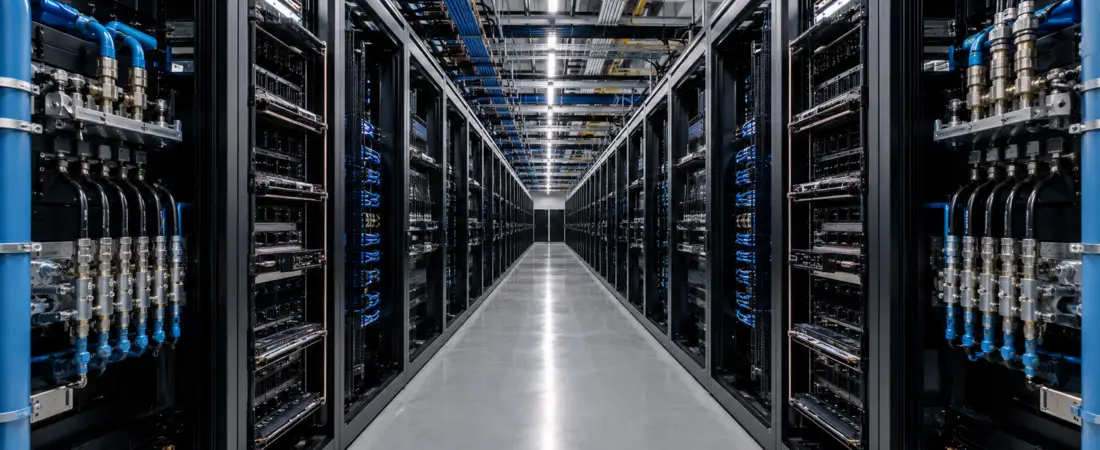
Air cooling remains appropriate for many lower-density or mixed deployments. At higher heat fluxes, liquid moves heat more effectively and can reduce reliance on server fans. In direct-to-chip systems, cold plates collect heat from processors and accelerators; a technology cooling system and coolant distribution unit transfer it to the facility loop. Some residual components may still require air cooling.
Immersion cooling submerges compatible IT equipment in dielectric fluid, using single-phase circulation or two-phase evaporation. It can support high densities but changes server construction, fluid handling, maintenance, warranties and fire-safety considerations. Rear-door heat exchangers and hybrid air-liquid arrangements provide further options. No single method fits every AI data center: server requirements, water availability, ambient conditions, supply temperatures, heat-reuse plans and operating capability determine the choice.
AI Training Versus Inference Infrastructure
Training optimizes a model through repeated computation across a dataset. Large jobs can run for extended periods, demand tightly synchronized accelerators and produce substantial checkpoint traffic. Throughput, fabric efficiency, job scheduling and recovery from interruption are central concerns.
Inference serves trained models. Some services prioritize low latency and predictable response times; others optimize batch throughput or cost per token. Model size, context length, concurrency and service-level objectives influence memory, networking and power. Distributed inference and retrieval-augmented generation can create demanding east-west and storage traffic. It is therefore wrong to classify all inference as simple or low-power.
Designing for Cluster-Level Resilience
Conventional applications often achieve availability by running redundant servers and failing traffic between them. A distributed training job may instead span hundreds or thousands of devices, so one node or link failure can interrupt coordinated work. Replicating every accelerator server is usually economically unattractive.
Resilience shifts toward failure-domain design, rapid fault detection, workload restart, checkpoint strategy, spare capacity and repair automation. Dual network planes can add resilience, but also cost and complexity. Power feeds, CDUs, pumps and heat rejection must map to cluster fault domains: redundant components are less useful if a shared dependency can disable the job.
Orchestration platforms such as Slurm and Kubernetes-based stacks allocate accelerators, place related tasks and manage queues. Kubernetes exposes GPUs through device plugins, while parallel jobs may also require gang scheduling so all necessary resources are available together. Operators need observability spanning job state, GPU errors and utilization, fabric congestion, storage latency, rack power, coolant flow, supply temperature, leaks and facility alarms. Correlating these signals is more useful than isolated dashboards.
Operational and Business Implications
- Capacity and deployment: Utility connections, switchgear, transformers, chillers or dry coolers and network optics can have longer lead times than servers. Phased, repeatable cluster blocks can reduce integration risk but may constrain flexibility.
- CAPEX and energy: Accelerators are only part of the investment. Fabrics, optical links, storage, UPS capacity and thermal plant can be material costs. Energy modeling should include realistic utilization and total facility power.
- Maintenance: Liquid loops introduce pumps, filters, water chemistry, connectors and leak detection. High-value clusters also make planned outages and firmware coordination commercially significant.
- Skills: Facilities, network, storage, platform and machine-learning teams must share capacity models and change controls. Boundaries between IT and operational technology become less useful when coolant or power telemetry affects job scheduling.
- Observability: Useful measures include job completion time, accelerator utilization, retransmissions, congestion, storage throughput, energy per unit of work and thermal margin. PUE alone cannot explain whether the AI workload is productive.
Challenges for Existing Data Centers
Retrofits are governed by the weakest link. Operators must verify structural floor and rack loading, clearances and service access; upstream electrical capacity and distribution; cooling-water routing; CDU locations; facility supply and return temperatures; heat-rejection capacity; drainage and leak management; and space for dense fibre cabling. Available utility power may be a harder constraint than white-space area.
Some sites can accommodate a contained high-density zone using dedicated busway, liquid-to-air heat dissipation or a new facility-water loop. Others have unsuitable switchgear, limited roof or yard space, low floor loading, insufficient risers or no economical route to more utility capacity. In those cases, partial deployment, a lower-density inference design, colocation capacity or substantial rebuilding may be more rational than forcing a training architecture into the facility.
What Data Center Operators Should Evaluate
- Define the model, training, fine-tuning and inference workloads, including concurrency and service objectives.
- Size the cluster and accelerator memory domain before choosing a vendor architecture.
- Model scale-up and scale-out traffic, topology, oversubscription and failure domains.
- Benchmark ingestion, metadata and checkpoint patterns against the proposed storage tiers.
- Calculate rack power, IT load and total facility demand under credible utilization and growth cases.
- Select air, direct-to-chip, rear-door, immersion or hybrid cooling from server and site conditions.
- Verify utility, UPS, generator and heat-rejection capacity, including maintenance states.
- Plan expansion in deployable blocks and define resilience, recovery and observability objectives.
Future Outlook
Confirmed developments include higher-power rack distribution, broader liquid-cooling portfolios, faster fabrics, Ultra Ethernet and more rack-scale accelerator designs. These will push facility and IT engineering toward closer co-design.
The outlook is less uniform than the marketing suggests. Training clusters may continue toward extreme density because short interconnects and fewer racks can improve system efficiency. Enterprise inference may favor smaller, distributed or hybrid deployments where latency, data sovereignty and utilization matter more than maximum density. Today’s most demanding designs should not become a template for every facility.
Conclusion
An AI factory is not a conventional data center filled with GPUs. It is a workload-specific production system in which accelerator nodes, networks, storage, electrical distribution, cooling and orchestration are engineered together. Operators moving toward accelerated computing must begin with the workload and its resilience objectives, then validate every dependency from grid to chip and data source to model output.
Frequently Asked Questions
What is an AI factory?
It is an industry term for integrated infrastructure that develops or operates AI models at scale. It is not a single standard and does not require one supplier’s technology.
How much power does an AI factory require?
There is no universal figure. Demand depends on accelerator type and count, utilization, storage and network equipment, rack layout, cooling architecture, redundancy and facility overhead. Operators should model both IT load and total facility power.
August 17, 2026 By: Joshua Anto