
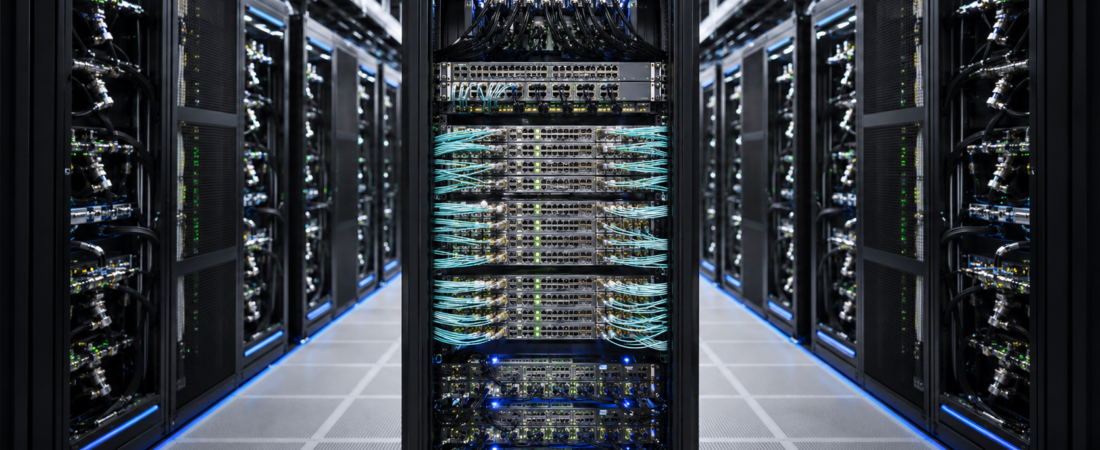
AI Network Fabric Design for 800G Clusters
An AI network fabric has a different job from a conventional enterprise data center network. It must move enormous quantities of data between accelerators while keeping thousands of GPUs synchronized, minimizing congestion, and preventing slow network flows from leaving expensive computing hardware waiting for data. As AI clusters expand, simply installing faster Ethernet ports is no longer enough.
The industry’s transition from 400G toward 800G networking illustrates the scale of the bandwidth problem, but line rate is only one part of AI network performance. Congestion control, adaptive routing, RDMA, topology, telemetry, network interface cards, switch architecture, and workload placement can determine how much of that theoretical bandwidth is actually available to applications.
For CIOs, CTOs, network architects, and data center operators, this distinction is increasingly important. A facility can contain thousands of high-performance GPUs and still deliver disappointing AI performance if the network fabric cannot keep those accelerators productively connected.
Executive Summary
AI network fabrics connect accelerated computing systems inside modern AI data centers. Unlike conventional enterprise networks dominated by application, storage, internet, and user traffic, AI fabrics must support highly synchronized communication between large numbers of accelerators.
800G Ethernet increases the amount of data that can move through each network interface, but bandwidth alone does not eliminate congestion. When many GPUs transmit simultaneously, traffic can converge on the same links and switches, creating queues and delaying parts of a distributed workload.
Modern AI Ethernet architectures therefore combine higher line rates with technologies such as remote direct memory access, adaptive routing, congestion control, multipathing, workload-aware telemetry, and increasingly sophisticated network interface cards.
The objective is not simply to build the fastest network. It is to create predictable communication between accelerators so that the cluster spends as much time as possible performing useful computation.
Why AI Creates A Different Network Problem
Traditional enterprise applications often communicate in relatively independent transactions. A database request, web session, storage operation, or API call may be important, but thousands of servers do not necessarily need to complete the same network operation at precisely the same moment.
Distributed AI training is different.
A large model may be divided across hundreds or thousands of GPUs. Those accelerators repeatedly exchange gradients, parameters, activations, tensors, or expert-routing information as the workload progresses.
Many of those operations are synchronized.
If one group of GPUs receives its data late, other accelerators may have to wait before proceeding. The network performance of the slowest communication path can therefore influence the performance of a much larger portion of the cluster.
This creates the straggler problem: a small number of delayed transfers can reduce overall computing efficiency.
GPU Utilization Is The Real Network Metric
For an AI data center, network performance ultimately matters because of its effect on accelerator utilization.
GPUs are among the most expensive components in an AI facility. They also consume substantial quantities of power whether or not every computing cycle is being used efficiently.
If an accelerator is waiting for data from another server, it is not delivering the full productive value of the capital and electrical capacity allocated to it.
That changes the economics of networking.
Spending more on switches, NICs, cabling, optics, and network software can be economically justified if the result is materially higher utilization across a large GPU fleet.
Infrastructure leaders should therefore evaluate AI network fabrics in terms of useful cluster performance rather than raw switch throughput alone.
Why 800G Ethernet Matters
800G Ethernet doubles the nominal bandwidth available from a 400G interface, making it increasingly important for large AI clusters. Our 800G Ethernet deployment guide examines switches, optics, cabling, and migration planning in detail.
Higher-speed interfaces allow servers to exchange more data while potentially reducing the number of physical ports, switches, cables, and optical modules required to deliver a given aggregate bandwidth.
This is particularly important as accelerator performance increases.
Faster GPUs create more data and can process it more quickly. Unless the network scales alongside the compute, communication becomes an increasingly significant percentage of job completion time.
But upgrading from 400G to 800G does not automatically double application performance.
A poorly designed 800G fabric can still suffer from congestion, packet loss, inefficient routing, oversubscription, or traffic imbalance.
Bandwidth Without Congestion Control Is Not Enough
AI clusters can create unusually bursty network traffic.
During collective communication operations, large numbers of accelerators may begin sending information at approximately the same time. Several flows can converge on one switch port even when other paths through the network remain relatively idle.
This can create congestion.
Buffers begin filling, latency increases, packets may be dropped, and applications can be forced to retransmit data. The resulting delays can propagate through synchronized workloads.
AI network fabrics therefore need mechanisms that respond quickly to congestion rather than simply relying on additional bandwidth.
Modern Ethernet implementations use combinations of congestion notification, queue management, traffic engineering, and endpoint controls to keep the fabric operating efficiently under heavy synchronized loads.
Adaptive Routing Makes The Fabric More Dynamic
Conventional networks often use equal-cost multipath routing to distribute traffic across several available paths.
That approach can work well for general-purpose applications, but AI traffic can expose its limitations. Hashing algorithms may place several large flows onto the same path while another route remains underused.
Adaptive routing attempts to make better decisions based on current network conditions.
Instead of treating every equal-cost route as equally desirable, the network can identify congestion and steer traffic toward paths with more available capacity.
NVIDIA’s Spectrum-X Ethernet architecture is one example of this approach, combining adaptive routing with endpoint congestion-control mechanisms for AI workloads.
The objective is to increase effective bandwidth across the entire fabric rather than allowing individual links to become persistent bottlenecks.
RDMA Reduces The CPU’s Role In Data Movement
Remote direct memory access, or RDMA, is another important technology in AI networking.
Traditional network communication can require the CPU and operating system to participate extensively in moving information between application memory and the network interface.
RDMA allows data to move more directly between memory resources across different systems, reducing CPU involvement and lowering latency.
Ethernet implementations commonly use RDMA over Converged Ethernet, or RoCE, to support high-performance distributed computing.
For AI clusters, the advantage is straightforward: processors spend less time managing network transfers, and accelerator communication can occur with lower overhead.
But RoCE also places greater demands on network engineering. Congestion, packet loss, queue behavior, and configuration need careful management if the environment is expected to deliver predictable performance at scale.
Lossless Does Not Mean Congestion-Free
AI Ethernet is frequently described as lossless networking.
The term can be misleading if interpreted too literally.
The objective is to minimize or prevent packet loss for critical traffic classes through mechanisms such as priority flow control and congestion management. That does not mean the network cannot become congested.
In fact, poorly configured lossless mechanisms can create their own problems.
Pausing traffic to prevent packet loss can cause congestion to propagate backward through the network. One overloaded destination can begin affecting unrelated flows if queue and priority design is poor.
This is why modern AI Ethernet architectures increasingly combine multiple mechanisms rather than relying on one form of flow control.
Topology Determines How Traffic Moves
The physical and logical topology of the AI network also has a direct impact on performance.
Leaf-spine architectures remain common because they can provide predictable paths and relatively uniform latency between servers. Large clusters can extend this model using additional switching tiers or multiple independent network planes.
But every additional tier adds equipment and potentially another point of congestion.
Network architects therefore need to balance scale against topology depth.
Oversubscription is another critical decision.
Traditional enterprise networks commonly assume that not every server will use its maximum network capacity simultaneously. AI training clusters can challenge that assumption because synchronized communication can drive many endpoints heavily at the same time.
A heavily oversubscribed network may save capital but reduce the value of the accelerators connected to it.
Multi-Plane Networks Can Spread AI Traffic
One approach to scaling AI Ethernet is to use multiple network planes.
Instead of connecting each server to one enormous switching fabric, bandwidth can be distributed across several independent fabrics. Traffic is then balanced across those planes.
This can reduce topology depth and create additional paths between computing systems.
It can also improve resilience because a failure in one plane does not necessarily remove all connectivity from a server.
However, the endpoints and software need to distribute traffic effectively. Multiple planes provide little benefit if most communication consistently uses only a fraction of the available paths.
NIC behavior therefore becomes increasingly important.
The NIC Is Becoming An Intelligent Infrastructure Component
Network interface cards were once relatively simple connectivity devices. AI is making them more sophisticated.
Modern high-performance NICs can participate in congestion control, telemetry, traffic steering, encryption, virtualization, and data processing.
DPUs and SmartNICs can go further by offloading networking, security, storage, and infrastructure services from host CPUs.
This matters because the network is increasingly controlled from both ends.
The switch can identify congestion inside the fabric, while the NIC can adjust how traffic is injected into that fabric. Coordinating those behaviors can produce better results than relying on the switching layer alone.
For infrastructure teams, NIC selection should therefore be part of network architecture rather than treated simply as a server specification.
Telemetry Is Essential For Finding Stragglers
AI networks need detailed observability because a fabric can remain technically operational while still degrading application performance.
A failed link is relatively straightforward to detect. A link experiencing intermittent congestion, excessive retransmissions, optical degradation, or abnormal latency is more difficult.
The GPUs may continue working, but jobs take longer.
High-resolution telemetry can help operators monitor queue occupancy, link utilization, packet drops, congestion events, latency, routing changes, and optical health.
The most valuable systems correlate those network metrics with workload behavior.
If a training job slows, the operations team should be able to determine whether the cause is compute, storage, software, or the network rather than investigating each infrastructure layer independently.
Optics Are Becoming A Power Problem
Moving to higher network speeds also has implications for data center power and cooling.
Large AI fabrics can contain thousands of optical transceivers. Each module consumes power and generates heat, and those requirements become significant when multiplied across a large cluster.
As networking progresses from 400G to 800G and eventually 1.6T, vendors are exploring different optical architectures to improve bandwidth per watt.
Linear pluggable optics, silicon photonics, and co-packaged optics are among the approaches being developed to reduce the electrical cost of moving enormous quantities of data.
This makes networking part of facility capacity planning.
Power reserved for switches and optics is power that cannot be allocated to GPUs.
Cabling Complexity Grows With Cluster Size
AI networking is also a physical cabling challenge.
Thousands of accelerator servers can require enormous numbers of copper and fiber connections. Incorrect patching, damaged connectors, contaminated fiber, poor labeling, and inconsistent cable management can all create reliability problems.
High-density racks leave limited physical space for routing cables while also supporting liquid-cooling hoses and power connections.
Network design therefore needs to consider serviceability.
A theoretically elegant topology can become operationally difficult if technicians cannot replace an optical module or cable without disturbing neighboring infrastructure.
Ethernet And InfiniBand Will Continue To Coexist
The growth of AI Ethernet does not mean InfiniBand will immediately disappear.
InfiniBand has a long history in high-performance computing and remains widely used for demanding AI clusters. Its integrated approach to low-latency communication and congestion management has made it attractive for tightly synchronized workloads.
Ethernet’s advantage is its enormous ecosystem.
Organizations already have Ethernet skills, tools, suppliers, standards, and operating experience. New AI-specific Ethernet architectures are attempting to combine that familiarity with performance characteristics required by accelerated computing.
The appropriate choice depends on workload requirements, scale, existing expertise, economics, and supplier strategy.
For many operators, the future may involve both technologies rather than one universal fabric.
What Infrastructure Leaders Should Evaluate
When designing an AI network fabric, infrastructure teams should evaluate the complete communication architecture rather than focusing only on interface speed.
- How much GPU-to-GPU communication does the workload generate?
- Is 400G sufficient, or does the cluster require 800G connectivity?
- What level of network oversubscription is acceptable?
- How does the fabric detect and respond to congestion?
- Does the architecture support adaptive routing?
- How is RDMA configured and monitored?
- What happens when a switch or link becomes degraded rather than failing completely?
- How many switching tiers are required?
- Would multiple independent network planes improve scale or resilience?
- What telemetry is available at the switch, NIC, and optical layers?
- Can network performance be correlated with GPU utilization?
- How much power is consumed by switches, NICs, and optics?
- Can technicians service cables and transceivers safely in high-density racks?
- Does the architecture provide a migration path toward 1.6T networking?
The goal is not maximum bandwidth everywhere. It is predictable communication performance at the points where the workload needs it.
Future Outlook
AI network fabrics will continue evolving as accelerator performance increases.
800G Ethernet is becoming an important building block for current high-density clusters, while 1.6T networking will push bandwidth higher again. But each increase in line rate will also raise new questions around optics, power, thermal management, cabling, switch silicon, and signal integrity.
Software will become increasingly important as well.
Networks will use more telemetry and automation to identify congestion, balance traffic, detect failing components, and adapt paths dynamically. Infrastructure teams may eventually manage AI fabrics less as static collections of switches and more as continuously optimized systems.
The underlying objective will remain unchanged: keep the accelerators working.
Frequently Asked Questions
What Is An AI Network Fabric?
An AI network fabric is the high-performance network connecting accelerator servers and supporting infrastructure within an AI data center. It is designed for high bandwidth, low latency, predictable congestion behavior, and the synchronized traffic patterns created by distributed AI workloads.
Why Is 800G Ethernet Used In AI Data Centers?
800G Ethernet provides substantially more bandwidth per interface than 400G, helping networks keep pace with faster accelerators and larger clusters. However, effective AI performance also depends on congestion control, topology, routing, NIC behavior, and software.
What Is RoCE?
RoCE stands for RDMA over Converged Ethernet. It allows remote direct memory access over Ethernet, reducing CPU involvement in data movement and supporting low-latency communication between high-performance computing systems.
Is Ethernet Better Than InfiniBand For AI?
Neither technology is universally better. InfiniBand remains strong in tightly coupled high-performance environments, while Ethernet offers a broad ecosystem and increasing AI-specific capabilities. The appropriate choice depends on workload, scale, operating expertise, cost, and infrastructure strategy.
Conclusion
An AI network fabric cannot be evaluated by port speed alone.
800G Ethernet provides the bandwidth required for increasingly powerful accelerator systems, but bandwidth has little value when congestion, inefficient routing, packet loss, poor topology, or limited observability prevents applications from using it.
The real measure of an AI network is what happens to the GPUs connected to it. Effective GPU cluster architecture and AI-ready operations must connect network telemetry with workload performance.
If accelerators remain highly utilized and distributed workloads communicate predictably, the fabric is doing its job. If expensive GPUs regularly wait for network transfers, headline bandwidth figures provide little consolation.
For data center leaders, networking has therefore become part of the economics of AI compute. Switches, NICs, optics, topology, congestion control, and telemetry determine how effectively billions of dollars of accelerator infrastructure can be converted into useful work.
In an AI factory, the network is no longer simply connecting the computers. It is part of the computer.