
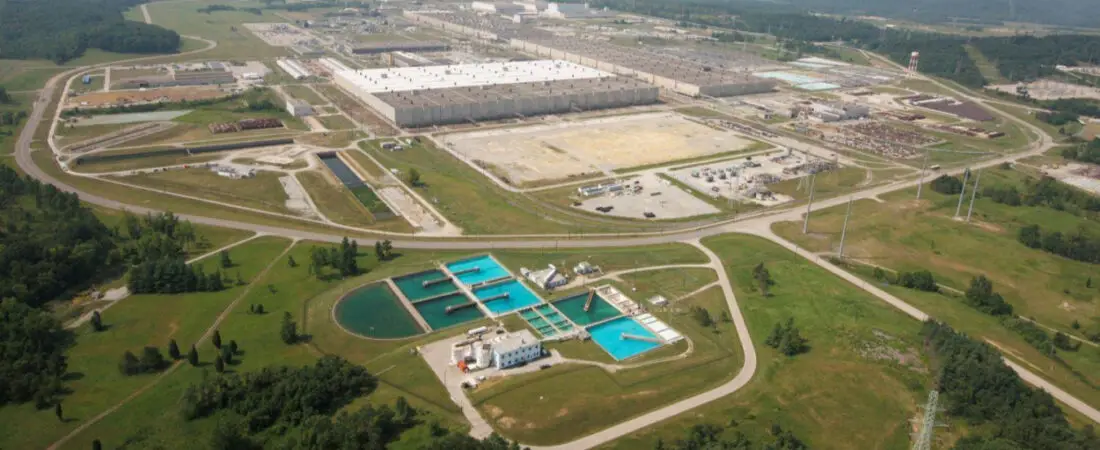
OpenAI has agreed to secure approximately 8 gigawatts of IT capacity at the PORTS-Pike Technology Campus in Pike County, Ohio, in an AI infrastructure project involving SB Energy, NVIDIA, and the U.S. Department of Energy. The OpenAI Ohio data center commitment is notable not only for its planned scale, but for the infrastructure model behind it: power, land, data center capacity, financing, and AI compute are being assembled as parts of the same long-term strategy.
Executive Summary
OpenAI announced on August 17 that it has entered into an agreement for approximately 8 IT-GW at PORTS-Pike. SB Energy will build, own, and operate the data center under a 20-year lease to OpenAI, while the site will exclusively host NVIDIA AI compute infrastructure.
NVIDIA said it will provide credit support for the land, power, and shell buildout associated with an initial 4.25 IT-GW and has an option covering the remaining 3.75 IT-GW. NVIDIA is also investing $1.5 billion in SB Energy.
The first 800MW is expected to become available in 2028, largely using existing AEP infrastructure. OpenAI says further development will require new generation, including natural gas, alongside new transmission infrastructure. The full development remains dependent on infrastructure delivery, permits, environmental reviews, financing, and other project milestones.
What OpenAI And Its Partners Have Announced
PORTS-Pike is being developed on private land and remediated land associated with the former Portsmouth Gaseous Diffusion Plant in southern Ohio. The U.S. Department of Energy had already announced a public-private partnership in March involving redevelopment of the site and new power infrastructure.
The latest agreements provide much greater clarity about who will consume the planned computing capacity.
OpenAI will be the customer for approximately 8 IT-GW. NVIDIA will be the exclusive AI compute infrastructure provider, while SB Energy will own and operate the data center.
NVIDIA says the initial deployment is designed for 4.25 IT-GW of AI factory capacity using its DSX AI factory platform, including GPUs, CPUs, and networking. The company has the option to extend its involvement across the remaining capacity.
Power Is Becoming Part Of The AI Compute Contract
The most consequential part of the announcement for data center operators may be what sits outside the server racks.
OpenAI says SB Energy will pay the full cost of grid upgrades and new transmission lines needed to serve the development rather than shifting those project-specific costs to regional ratepayers. NVIDIA’s announcement says SB Energy and SoftBank plan at least 10GW of new energy generation and at least $4.2 billion of new regional grid infrastructure.
The distinction is important. At multi-gigawatt scale, acquiring accelerators is only one part of the capacity problem. Developers must simultaneously secure generation, transmission, substations, land, cooling, buildings, financing, and permission to construct them.
That changes the meaning of AI infrastructure procurement. The scarce resource is increasingly not an individual GPU or rack, but a viable location where enormous quantities of compute can actually be energized.
Why The PORTS-Pike Model Matters
NVIDIA describes land, power, and shell capacity as a strategic resource for AI factories. That framing reflects a broader shift in the market.
Instead of waiting for conventional data center supply to become available and then installing computing equipment, major AI companies and their infrastructure partners are becoming involved much earlier in the development chain.
For CIOs and infrastructure leaders, the significance extends beyond OpenAI. If this model expands, competition for AI capacity could increasingly be determined years before servers are deployed. Long-term access to power and suitable sites may become as strategically important as accelerator roadmaps.
The structure also redistributes risk. OpenAI says it will begin paying as completed capacity becomes available for lease. NVIDIA is supporting the initial land, power, and shell development, while SB Energy carries the role of developer, owner, and operator.
That is materially different from treating the data center as a standardized facility that can be procured after computing requirements have been decided.
Technical Ambitions Extend Beyond Raw Megawatts
OpenAI and NVIDIA also intend to collaborate on the design, testing, and commissioning of the facility. The companies say they plan to publish a technical white paper covering lessons from PORTS-Pike.
According to OpenAI, that work will examine resilient infrastructure design, data center component qualification, and software-level workload management as mechanisms for improving compute availability, reliability, and mean time between interruptions at cluster scale.
This is significant because AI resilience increasingly crosses the boundary between facility engineering and computing architecture. A very large training environment cannot assume that every component will remain available indefinitely. Software orchestration, workload recovery, hardware qualification, and physical infrastructure resilience therefore have to be considered together.
The 8GW Figure Comes With Important Conditions
The announced scale should not be confused with capacity that exists today.
OpenAI says the project will be developed over time, with the first 800MW expected in 2028. Later development requires additional generation and transmission, and the company explicitly states that development depends on necessary infrastructure, permits, environmental reviews, and financing being in place.
Those conditions matter when evaluating multi-gigawatt AI announcements. The engineering and regulatory challenge of delivering power at this scale is substantial, and projected capacity several years into the future should be treated as planned infrastructure rather than operating capacity.
What Happens Next
The immediate milestones will be infrastructure delivery and the progression of the first 800MW toward the planned 2028 availability date.
The project will also provide an important test of whether the emerging power-first AI development model can deliver capacity at the scale and speed now being contracted by frontier AI companies.
For data center leaders, PORTS-Pike points toward a market in which compute strategy and energy strategy can no longer be separated cleanly. The largest AI deployments are becoming power-development projects, grid projects, construction projects, and computing projects at the same time.
Conclusion
OpenAI’s approximately 8 IT-GW PORTS-Pike commitment is remarkable for its size, but the structure behind the number may prove more important.
NVIDIA is moving beyond supplying processors by helping secure the land, power, and shell required to operate them. SB Energy is combining data center development with large-scale energy infrastructure. OpenAI is locking in computing capacity years ahead of full delivery.
If that approach becomes common, the competitive advantage in AI infrastructure will increasingly belong to organizations capable of coordinating silicon, capital, power, land, networks, and construction as one system. For the data center industry, that is a much bigger change than simply building larger facilities.