
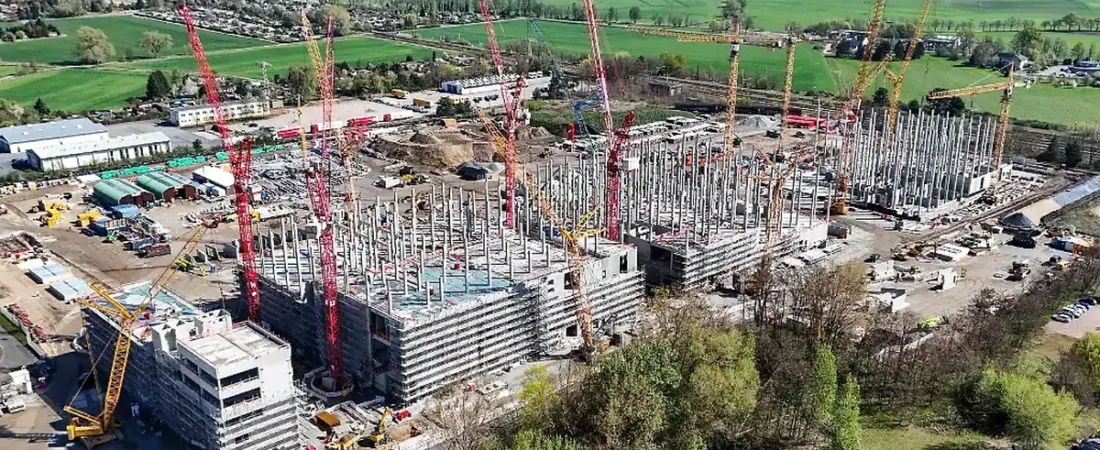
Schwarz Group Data Center and European Sovereign AI
The Schwarz Group data center planned for northern Germany represents an investment of up to €5.6 billion and could create a major platform for sovereign cloud and AI infrastructure in Europe. The proposed 240MW development would be located in Dummerstorf, Mecklenburg-Western Pomerania, with construction expected to begin in 2027 and initial capacity targeted for completion by 2033.
The group, best known as the owner of Lidl and Kaufland, is increasingly building a substantial technology business through Schwarz Digits and its STACKIT cloud platform. The project shows how European companies outside the traditional hyperscale cloud market are investing directly in the physical infrastructure required to support AI and sovereign digital services.
1. What Schwarz Group Has Announced
Schwarz Group and the government of Mecklenburg-Western Pomerania announced the project on August 27 as part of a wider infrastructure and digitalization partnership.
The planned facility would provide approximately 240MW of capacity, representing an estimated investment of up to €5.6 billion by 2033. The site under consideration is located in an industrial park in Dummerstorf, near Rostock.
Schwarz Group says there is also a longer-term opportunity to expand the site’s grid connection to as much as 1GW by 2045.
The project remains at an early stage. The company says detailed technical specifications, including the exact configuration requirements for cloud and AI chips, have not yet been finalized.
2. Digital Sovereignty Is a Central Objective
The investment is significant because it is being positioned as more than additional commercial data center capacity.
Schwarz Group says the facility will support cloud and AI services operated under German law, strengthening digital sovereignty and keeping more digital infrastructure and value creation within Germany and Europe.
This issue has become increasingly important as European governments and enterprises examine their dependence on overseas technology providers for cloud computing, AI infrastructure, cybersecurity, and sensitive public-sector workloads.
Schwarz Digits already operates STACKIT, its sovereign cloud platform, alongside cybersecurity and digital workplace services. A large dedicated data center could give that strategy considerably more physical computing capacity. Our guide to sovereign cloud strategy in 2026 examines the wider governance and infrastructure implications.
3. Power Availability Shapes the Site Strategy
The proposed location highlights the increasingly close relationship between data center development and electricity infrastructure.
Schwarz Group identified northern Germany’s availability of renewable electricity, including onshore and offshore wind generation, as one advantage of Dummerstorf.
The proposed site can also connect to the 380kV extra-high-voltage network. For a facility eventually targeting hundreds of megawatts, access to high-capacity transmission infrastructure can be as important as the land itself.
The company plans to use renewable energy exclusively during normal operations. That commitment will still require careful planning because AI and cloud infrastructure operate continuously while renewable generation varies with weather. Grid integration, procurement strategy, and available firm capacity will remain important as the project develops.
4. Waste Heat Could Support District Heating
Schwarz Group is also exploring the use of data center waste heat.
A letter of intent has been signed with Rostock’s municipal utility covering the potential use of heat from the facility within a district heating network.
Heat reuse is an increasingly important part of European data center sustainability strategies. Servers convert most of the electricity they consume into heat, creating an opportunity to supply nearby buildings when temperature levels, distance, infrastructure, and demand make recovery practical.
The Dummerstorf project could benefit from its proximity to Rostock, although the final scale and economics of the heat-reuse system have not yet been determined.
5. Cooling Will Use Northern Germany’s Climate
Schwarz Group says the regional climate provides opportunities for efficient free cooling using outside air.
This is relevant because cooling can represent a substantial supporting energy load in large data centers. Cooler ambient conditions can reduce the hours in which energy-intensive mechanical refrigeration is required.
The precise cooling architecture has not been finalized, and the company notes that technical requirements will depend partly on the cloud and AI hardware eventually deployed.
That distinction matters. Future high-density AI systems may require substantially different thermal architectures from conventional cloud servers, including direct liquid cooling for the highest-power accelerators. Readers can explore the engineering trade-offs in our analysis of closed-loop liquid cooling for AI data centers.
6. Why the Project Matters for European AI Infrastructure
The Schwarz Group data center illustrates a broader change in the European infrastructure market.
Cloud sovereignty is moving from a software and procurement discussion into a physical capacity question. European organizations can run sovereign AI services at meaningful scale only when sufficient computing, storage, networking, power, and data center capacity exist within the appropriate jurisdiction.
That requires substantial capital. A planned €5.6 billion investment from a company whose core business was historically retail demonstrates how strategically important digital infrastructure has become outside the traditional technology sector.
The project could also create another significant customer for high-density servers, networking equipment, power systems, cooling technology, and AI accelerators. It fits the broader shift toward AI factories and accelerated-computing facilities.
7. Infrastructure Milestones to Watch
Construction is expected to begin in 2027, with 240MW planned by 2033. Schwarz Group says the facility could eventually expand toward a 1GW grid connection by 2045. Those figures should be treated as development targets rather than capacity already under construction.
- Planning and approvals: final land, environmental, construction, and grid decisions.
- Power delivery: transmission capacity, renewable procurement, backup power, and firm supply.
- Technical design: the selected cloud and AI hardware, rack density, network, and storage architecture.
- Cooling: the balance between free cooling and direct liquid cooling for high-density systems.
- Heat reuse: commercial and engineering agreements with the Rostock district-heating network.
- Operational readiness: commissioning, staffing, maintenance, security, and resilience procedures.
The company will need to demonstrate how its renewable-energy and heat-reuse plans translate from project objectives into operating infrastructure.
Frequently Asked Questions
Where will the Schwarz Group data center be built?
The proposed site is in an industrial park in Dummerstorf, Mecklenburg-Western Pomerania, near Rostock in northern Germany.
How large is the planned facility?
Schwarz Group is planning approximately 240MW of initial capacity and says the site’s grid connection could have longer-term expansion potential of up to 1GW by 2045.
When could the data center become operational?
Construction is expected to begin in 2027, with the planned 240MW capacity targeted for completion by 2033. The schedule remains dependent on design, approvals, power delivery, and construction milestones.
How does the project support digital sovereignty?
The facility is intended to provide physical capacity for cloud and AI services operated under German law, including services associated with Schwarz Digits and STACKIT.
Conclusion
Schwarz Group’s proposed €5.6 billion German data center is significant not only because of its size but because of the strategy behind it.
The company is combining data center capacity, sovereign cloud services, AI infrastructure, renewable power, and public-sector digitalization into a long-term European technology platform.
For data center leaders, the project indicates that the AI infrastructure market is expanding beyond hyperscalers and specialist colocation providers. Retail groups, governments, sovereign cloud operators, and other large enterprises increasingly see control of physical computing capacity as a strategic asset.
In Europe, digital sovereignty is becoming an infrastructure buildout.