
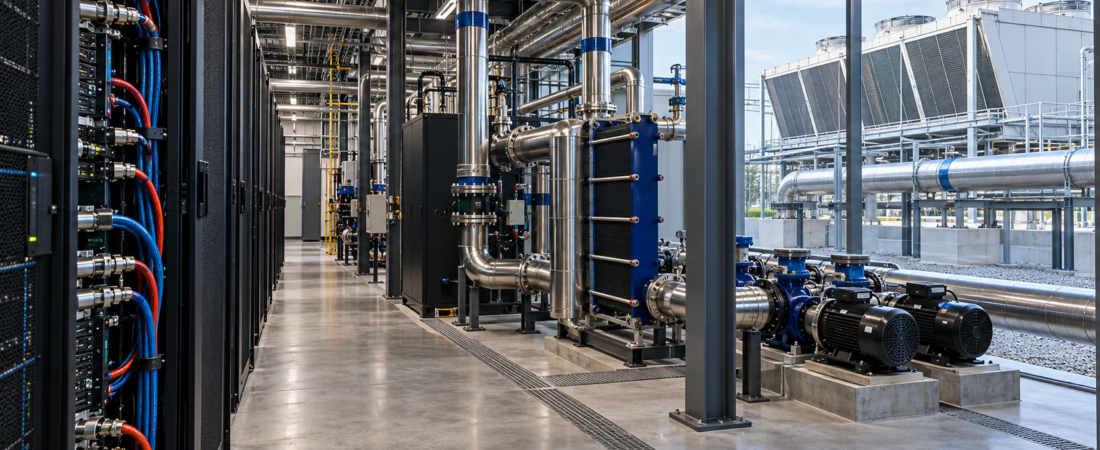
Data center water efficiency depends on the complete path that heat takes from processors to the environment. A liquid-cooled server can operate inside a recirculating coolant loop while the facility still consumes water elsewhere. Understanding that distinction is essential for infrastructure teams evaluating cooling proposals, capacity commitments, and sustainability claims.
The practical question is where heat goes after it leaves the rack. Following that path reveals the equipment, operating conditions, and measurement boundaries that determine actual water demand. It also helps buyers distinguish an efficient component from an efficient facility.
Start With The Complete Heat Path
The U.S. Department of Energy’s cooling-water guidance illustrates an important example: heat can pass through several recirculating loops before reaching an evaporative cooling tower. Keeping water inside an IT cooling loop does not eliminate evaporation at the final heat-rejection stage.
For a design review, request a diagram that follows heat from the equipment to its final destination. Identify where fluids circulate, where heat crosses a heat exchanger, where water enters the site, and where water leaves. Ask the designer to describe normal operation, hot-weather operation, and operation during equipment maintenance.
This review should produce an understandable operating narrative. A procurement team should be able to explain which equipment runs in each mode and which modes require additional water. If that explanation is missing, a headline efficiency claim is difficult to evaluate.
Separate Server Cooling From Facility Cooling
Direct-to-chip cooling transfers heat through cold plates attached to components. Immersion systems transfer heat into a surrounding dielectric fluid. Both describe how heat leaves IT equipment; neither description specifies the complete arrangement outside the data hall.
The Open Compute Project’s March 2026 cooling guidance distinguishes equipment cooling from facility cooling and emphasizes the interaction between water, energy, location, and heat reuse. Higher operating temperatures can expand opportunities for dry heat rejection, subject to equipment requirements and local conditions.
Infrastructure buyers should therefore ask vendors to connect their server-level claims to the proposed building systems. What coolant temperatures are required? Which components still need room cooling? What facility equipment supports those requirements? What changes when a different server generation is installed?
The resulting specification should identify the conditions under which performance is expected. Treat an unqualified claim about “liquid cooling” as an invitation to request the missing system details.
Understand Where Cooling Water Goes
In an evaporative cooling tower, some circulating water evaporates to remove heat. Additional water leaves through blowdown, which controls the accumulation of dissolved minerals. Smaller losses can occur through drift, while leaks and overflows represent avoidable losses.
DOE’s cooling-tower management guidance explains that reducing blowdown can lower makeup-water demand, but operating limits depend on water chemistry. Increasing concentration without appropriate treatment can create scaling and corrosion problems.
For operators, the recommended starting point is a water balance supported by measurements. Record the water entering the cooling system and the water discharged from it. Investigate unexpected changes rather than assuming that every increase reflects more computing activity.
Assign responsibility for reviewing the records. A dashboard is useful only if an accountable team examines deviations, identifies their causes, and confirms that corrective work restored expected performance.
Use Water Metrics With Clear Boundaries
DOE describes site water usage effectiveness, or WUE, as annual site water use divided by annual IT equipment energy use, expressed in liters per kilowatt-hour. Power usage effectiveness, or PUE, compares total facility energy with IT equipment energy. Together, they provide complementary views of operation.
Every reported result should state its boundary. Does the water figure cover cooling alone or the entire property? Is the result measured, modeled, or a design target? Does it represent one facility or an average across several sites? Are the energy and water figures drawn from the same period?
Keep absolute water volumes alongside ratios. In a hypothetical example, a facility using 10 million liters over 10 million IT kilowatt-hours has a WUE of 1.0 liter per kilowatt-hour. If both quantities double, its WUE remains unchanged while its water demand doubles.
This arithmetic illustrates why an efficiency ratio cannot answer every planning question. A utility assessing supply capacity needs volumes and timing as well as normalized performance.
Compare Metrics Before Accepting A Claim
| Measure | What It Shows | What It Cannot Show Alone |
|---|---|---|
| WUE | Site water use relative to IT energy. | Total demand, peak flow, or local scarcity. |
| PUE | Total facility energy relative to IT energy. | Water consumption or source impacts. |
| Absolute Volume | Water delivered or consumed during a period. | Efficiency relative to computing output. |
Distinguish Withdrawal From Consumption
The U.S. Geological Survey distinguishes water withdrawal from consumptive use. Withdrawal describes water removed from a source. Consumptive use describes the portion evaporated or otherwise removed from the immediate water environment. Return flows are another part of the accounting.
Use those terms consistently in customer reporting. Where a meter measures delivered water, label the result accordingly. Explain how any consumption estimate was calculated and what assumptions it contains. Clear terminology makes comparisons more useful and reduces the risk of overstating an improvement.
Evaluate Annual Performance And Peak Conditions
A practical evaluation should request both annual estimates and a description of demanding operating periods. Ask for performance assumptions at the proposed IT load, local weather conditions, and required equipment temperatures. Require the design team to explain how those assumptions were selected.
For systems offering several operating modes, request a mode-by-mode schedule. Identify when water-assisted operation begins, how it is controlled, and what happens if water availability is restricted. Include maintenance and contingency scenarios in the review. This is especially important when comparing warm-water liquid cooling with designs that require lower coolant temperatures.
These questions turn an annual efficiency promise into a testable operating plan. They also give facilities teams a basis for deciding which measurements and alarms should be included at commissioning.
Improve Existing Systems Before Choosing A Retrofit
DOE recommends metering makeup and blowdown flows, monitoring conductivity, and maintaining operating records. These measures help teams assess cooling-tower behavior and identify departures from intended conditions.
The General Services Administration’s alternative water-treatment guidance adds an important verification point: savings assessments should measure water flows before and after treatment changes. Conductivity alone may not capture the net effect of some treatment technologies.
Before approving a retrofit, establish a baseline and agree on the acceptance method. Specify which meters will be used, how changes in load and weather will be considered, and who will validate the result. Include treatment inputs, discharge requirements, maintenance effort, and electricity use in the commercial review.
This approach gives the operator a defensible comparison between continued optimization and equipment replacement. It also makes vendor guarantees easier to interpret.
Assess Alternative Water Supplies As Operating Systems
DOE identifies potential alternative cooling-tower supplies including air-handler condensate and suitable reclaimed wastewater. Their suitability depends on availability, quality, and compatibility with the cooling system.
For a proposed alternative supply, request a separate operating assessment. Who supplies it? What quality is guaranteed? What treatment is required? What happens during an interruption? Which organization owns the connecting infrastructure and pays for maintenance?
Report the intended benefit precisely. Replacing potable makeup water can reduce demand on drinking-water supplies, but the project should separately account for total water delivered and water consumed. Procurement documents should state which outcome the investment is expected to achieve.
Make Verification Part Of Procurement
A useful cooling proposal should include a heat-flow diagram, a water-accounting boundary, expected operating modes, and a measurement plan. Require assumptions to accompany every performance figure and distinguish modeled results from operating evidence.
For colocation purchases, ask how shared cooling water is allocated to customers and how reports will change as occupancy grows. For owned facilities, assign ownership of meters, calibration records, control settings, and performance reviews before handover.
DOE’s data center design guidance recognizes that efficiency measures interact across IT, cooling, electrical systems, and heat recovery. Procurement should reflect that system-wide perspective.
Require A Commissioning Evidence Package
- Calibrated meter records for makeup, blowdown, discharge, and relevant energy use.
- Verified control sequences for normal, peak-weather, maintenance, and restricted-water modes.
- Acceptance tests completed at representative load and documented environmental conditions.
- Named owners for alarms, calibration, treatment, reporting, and corrective action.
- A baseline that supports comparison after occupancy, equipment refreshes, and control changes.
The package should remain available to operations teams after handover. Commissioning evidence becomes more valuable when it can be compared with later performance and used to investigate deviations. This evidence also supports reporting to customers, utilities, and communities.
Frequently Asked Questions
Does Liquid Cooling Eliminate Facility Water Use?
No. A closed equipment loop can still transfer heat to facility systems that use evaporation. The complete heat-rejection path determines actual site water demand.
Should Operators Track Ratios Or Absolute Volumes?
Both. Ratios support normalized comparison, while absolute volumes show supply requirements and community impact. Reports should also identify measurement boundaries, time periods, and whether figures are measured or modeled.
Follow The Heat, Then Verify The Water
The most useful water-efficiency claim is one an operating team can explain and measure. Trace heat beyond the rack, identify every water input and discharge, and evaluate performance under documented conditions. Then compare expected results with measured operation.
That process gives managers a stronger basis for choosing cooling infrastructure, assessing supplier claims, and explaining resource demand to customers and communities.
October 26, 2026 By: Joshua Anto.