
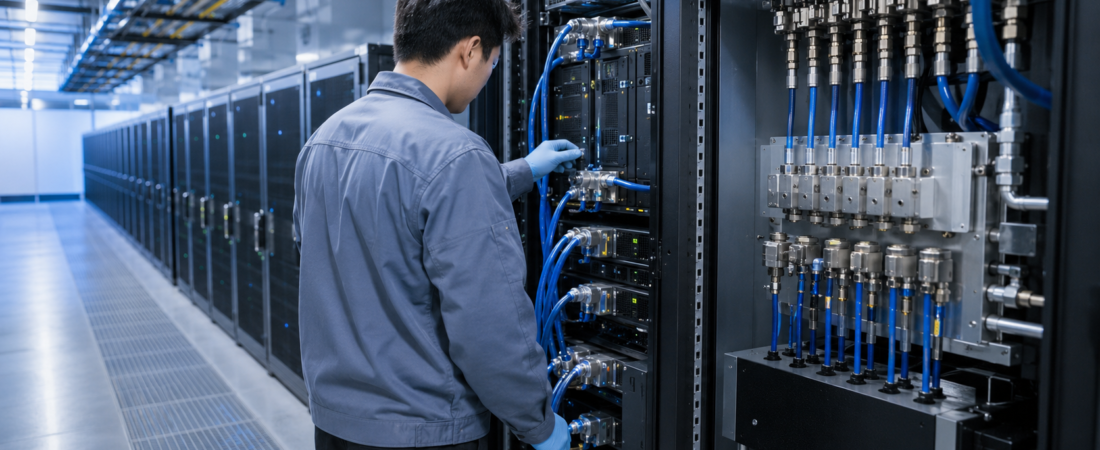
Direct-to-Chip Cooling: 15 Critical AI Data Center Checks
Direct-to-chip cooling is moving from a specialist high-performance computing technology into the mainstream of AI-ready data center design. As accelerator densities rise, operators increasingly need to remove heat directly from GPUs, CPUs, memory, and networking components rather than relying entirely on conditioned air moving through the room.
The attraction is straightforward. Liquid can move heat far more efficiently than air, allowing facilities to support substantially higher rack densities while reducing the amount of airflow required around the IT equipment. But direct-to-chip cooling is not simply a server feature. It introduces a new thermal infrastructure layer involving cold plates, manifolds, coolant distribution units, pumps, heat exchangers, water chemistry, leak detection, controls, and facility heat rejection.
For CIOs, CTOs, and data center operators, the important question is therefore not whether liquid cooling can support AI hardware. It can. The harder question is whether the entire facility can operate that cooling architecture reliably throughout the life of the equipment.
Executive Summary
Direct-to-chip cooling transfers heat from high-power processors into liquid through cold plates attached directly to those components. Coolant flows through the cold plates, leaves the server through hoses or quick disconnects, passes into rack or row manifolds, and then returns to a coolant distribution unit, or CDU.
The CDU controls coolant flow, pressure, and temperature while transferring heat from the technology cooling loop into the facility cooling system. The facility then rejects that heat through equipment such as dry coolers, chillers, cooling towers, or other heat-rejection systems.
How Direct-To-Chip Cooling Works
The basic principle is simple: capture heat as close to the processor as possible.
A cold plate is mounted directly onto a GPU, CPU, or other high-heat component. Coolant passes through internal channels in the plate and absorbs heat from the silicon. The warmer fluid then leaves the server and flows through a wider cooling circuit.
The CDU Becomes Mission-Critical Infrastructure
The coolant distribution unit is central to the architecture.
A CDU can contain pumps, heat exchangers, filters, sensors, control systems, valves, and other components required to maintain stable conditions for the IT loop. It monitors factors such as supply temperature, return temperature, pressure, and flow.
Liquid Cooling Does Not Eliminate Heat Rejection
One of the most common misconceptions is that liquid cooling somehow removes the facility’s cooling requirement.
It does not.
Warm-Water Cooling Can Reduce Mechanical Cooling
Higher coolant temperatures can improve facility efficiency because they make it easier to reject heat without mechanical refrigeration.
NVIDIA says its Rubin-generation AI systems can operate with cooling liquid at temperatures up to 45 degrees Celsius and are designed around 100% liquid cooling with no fans in the system.
Direct-To-Chip Does Not Always Remove Air Cooling
Many current direct-to-chip systems remove most, but not necessarily all, of the rack’s heat through liquid.
Components such as power supplies, storage devices, memory, network interfaces, voltage regulators, or other electronics may still reject some heat into the surrounding air.
Water Chemistry Becomes An Operational Discipline
A liquid loop introduces chemistry into an environment that many IT teams have historically not needed to manage directly.
Coolant quality can influence corrosion, biological growth, particulates, pump performance, heat-transfer efficiency, and the reliability of cold plates and heat exchangers.
Leak Detection Needs To Be Designed In
The presence of liquid close to expensive electronics naturally raises concerns about leaks.
Modern systems are designed to minimize that risk through engineered connectors, hoses, pressure controls, and leak-detection systems, but no mechanical system should be assumed to be incapable of failure.
Redundancy Needs To Follow The Cooling Chain
A data center may have redundant chillers and pumps at the facility level but still contain single points of failure closer to the IT equipment.
Direct-to-chip architectures need end-to-end failure-domain analysis.
Monitoring Should Cross Facility And IT Boundaries
Liquid cooling brings mechanical telemetry much closer to the computing workload.
A GPU temperature alarm can originate from the chip itself, a cold plate, restricted flow, a failed pump, a blocked filter, incorrect control logic, or a problem in the facility water loop.
Retrofitting Existing Data Centers Requires More Than A CDU
Direct-to-chip cooling is relatively straightforward to plan in a new facility because pipework, plant rooms, CDU locations, floor loading, service clearances, controls, and heat rejection can all be designed together.
Retrofitting an existing building is more difficult.
What Operators Should Establish Before Deployment
Before accepting high-density direct-to-chip infrastructure, operators should establish the complete cooling operating model.
- What percentage of each rack’s heat is captured by liquid?
- What coolant supply and return temperatures are required?
- What flow rates and pressure ranges must be maintained?
- Where are the CDUs located and what loads depend on each unit?
- What level of pump and heat-exchanger redundancy is provided?
- Who owns coolant chemistry and water-quality management?
- How are leaks detected, isolated, and escalated?
- Can individual racks or rows be isolated without affecting the wider system?
- How much residual room-level air cooling remains necessary?
- Can the facility heat-rejection system support the expected load?
- What telemetry is available to both IT and facilities teams?
- How will maintenance be performed while production workloads remain active?
- What critical spare parts need to be stored onsite?
- Who owns each part of the cooling chain in a colocation environment?
- Can the architecture support future racks with higher heat loads or different coolant requirements?
The objective is not simply to prove that the facility can cool today’s hardware. It is to create an operating model that can evolve as accelerator generations change.
Frequently Asked Questions
What Is Direct-To-Chip Cooling?
Direct-to-chip cooling uses cold plates attached directly to high-heat components such as GPUs and CPUs. Liquid flows through those cold plates and carries heat into a coolant distribution system before transferring it to the facility cooling infrastructure.
Does Direct-To-Chip Cooling Eliminate Air Cooling?
Not always. Many systems still release some heat into the surrounding air from components that are not connected to cold plates. Fully liquid-cooled systems are emerging, but operators should verify the residual air load for each platform.
What Does A CDU Do?
A coolant distribution unit circulates and controls coolant within the technology cooling loop and transfers heat to the facility water system through a heat exchanger. It can also monitor flow, pressure, temperature, and other operating conditions.
Does Liquid Cooling Reduce Water Use?
A closed technology loop recirculates coolant and can use very little makeup water, but total facility water consumption depends on how the captured heat is rejected. Cooling towers and other evaporative systems can still consume significant water.
Can Existing Data Centers Retrofit Direct-To-Chip Cooling?
Yes, but retrofit feasibility depends on available plant capacity, pipe routes, CDU space, facility water temperatures, heat rejection, electrical capacity, rack layout, controls, and operational requirements. A retrofit should be assessed as a facility-wide project rather than a server-only upgrade.
Conclusion
Direct-to-chip cooling is becoming a foundational technology for high-density AI infrastructure, but its value extends beyond its ability to remove more heat from a rack.
It changes how data centers are designed, commissioned, monitored, maintained, and operated. Pumps, CDUs, manifolds, chemistry, controls, leak management, heat rejection, and IT workloads become parts of the same thermal system.
For data center leaders, the key risk is treating liquid cooling as a hardware procurement decision. Installing cold plates and connecting a CDU is only the beginning.
The more important work is building an operational cooling chain that remains reliable when pumps fail, components are serviced, workloads change, and the next generation of accelerators arrives with different requirements.
That is what will separate facilities that are technically capable of accepting liquid-cooled racks from those that are genuinely ready to operate AI infrastructure at scale.
August 29, 2026 By: Joshua Anto.
Direct-to-Chip Cooling Deployment Steps
- Map the thermal load. Record rack power, liquid heat-capture percentage, residual air load, inlet temperature, required flow, pressure limits, and expected accelerator growth before selecting equipment.
- Design resilient cooling paths. Confirm pump, CDU, heat-exchanger, valve, control, and facility-loop redundancy. Model each failure domain and document which racks could lose cooling during maintenance or equipment failure.
- Integrate power and operations. Align cooling design with GPU cluster architecture, rack power, workload migration, alarms, emergency shutdown logic, and the procedures used by IT and facilities teams.
- Commission realistic failures. Test full production heat loads, failed pumps, blocked filters, bad sensors, elevated facility-water temperatures, leak alarms, automatic isolation, and recovery steps before live workloads enter the hall.
- Plan for future capacity. Validate that pipework, manifolds, CDUs, controls, and heat rejection can support higher-density racks. Pair the cooling roadmap with data center power planning so thermal and electrical capacity expand together.
Teams should assign owners for coolant chemistry, alarms, maintenance, spare parts, incident escalation, and post-event review. Quarterly drills should verify response times and expose unclear service boundaries before an actual cooling event threatens production availability. Record test results and convert each finding into a tracked corrective action with ownership.
Before approving deployment, leaders should review vendor warranties, connector compatibility, coolant specifications, monitoring integration, service access, maintenance windows, staffing coverage, and emergency procedures. The final design must show how operators will isolate faults, protect workloads, restore cooling, document incidents, and expand capacity without creating hidden single points of failure across the data hall during future accelerator upgrades.