
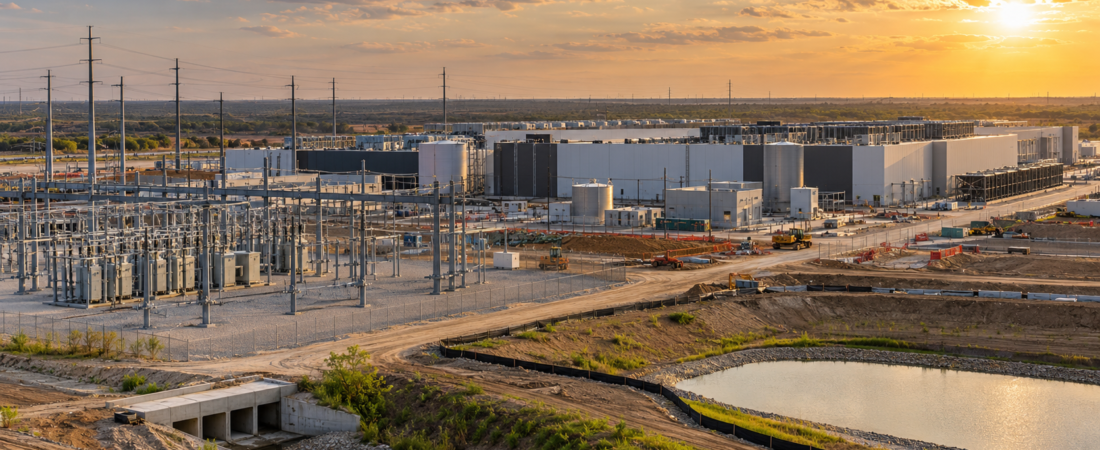
Texas data center permits are under renewed scrutiny after Public Citizen reported that state regulators suspended at least 17 authorizations issued following a September permitting halt. The development puts environmental approvals alongside power and water availability as immediate concerns for developers, operators, investors, and infrastructure customers assessing future capacity in the state.
The distinction between confirmed policy and disputed implementation matters. Gov. Greg Abbott’s September 21 directive instructed the Texas Commission on Environmental Quality, or TCEQ, to halt permits sought by data centers until the Electric Reliability Council of Texas completes an audit. TCEQ’s stormwater permitting page displays a notice reflecting that instruction.
What remains less certain is the precise number and status of individual authorizations affected. Public Citizen says at least 17 permits were suspended. Government Technology reported that TCEQ acknowledged suspending specific permits identified by watchdog groups but had not independently confirmed the total. The figure should therefore remain attributed, and it should not be converted into a count of canceled campuses.
What Is Confirmed About The Permit Pause
The governor’s September 21 announcement says TCEQ was directed to halt all permits sought by data centers until ERCOT completes its audit. It also says regulatory approvals should not advance until the Public Utility Commission of Texas, ERCOT, and the Texas Water Development Board have information needed to assess electricity and water demand.
The directive connects environmental permitting to broader infrastructure questions. It follows state actions addressing grid interconnection and water-use reporting, and it requires TCEQ to align permitting decisions with those reviews. That establishes the policy backdrop for current agency decisions.
TCEQ’s official stormwater permits page carries a special notice saying the governor directed the agency to halt permits related to data center projects until ERCOT completes its review. The notice confirms the pause at a program level, but it does not provide a project-by-project register of applications, approvals, suspensions, or withdrawals.
Why The Suspension Count Requires Attribution
In an October 22 statement, Public Citizen said TCEQ had suspended at least 17 permits after investigations conducted with FracTracker Alliance. The organization said agency records showed permits labeled approved and active with start dates after the governor’s directive.
Public Citizen is an advocacy organization challenging TCEQ’s implementation of the pause. Its statement is relevant evidence and identifies a specific count, but the count is not equivalent to an independent agency inventory. Responsible reporting must identify the source of the claim and separate it from TCEQ’s position.
Government Technology reported on October 23 that TCEQ acknowledged suspending specific permits identified by the watchdog organizations while maintaining that it had complied with Abbott’s instruction. The publication said TCEQ had not independently confirmed the total of 17.
Accordingly, the number should not be presented as a final state tally. It also should not be interpreted as 17 separate data center campuses. A single development can involve multiple environmental approvals, filings, amendments, generators, construction areas, or related facilities. Conversely, an authorization can cover activity that is only one part of a much larger project.
What The Public Record Does And Does Not Show
| Question | Current Evidence |
|---|---|
| Is there a statewide permit pause? | Yes. The governor’s directive and TCEQ notice confirm it. |
| Were specific authorizations suspended? | TCEQ acknowledged suspending permits identified by watchdog groups. |
| Is 17 an official agency total? | No independent TCEQ confirmation was reported. |
| Were 17 campuses canceled? | No. The available sources do not support that conclusion. |
| How long will projects be delayed? | The reviewed sources do not quantify project-specific delays. |
What Texas Data Center Permits Cover
TCEQ’s stormwater guidance covers water-quality requirements for runoff from construction sites, industrial facilities, and public storm sewer systems. Construction stormwater authorization can affect clearing, grading, excavation, and other site-preparation work. It serves a different function from an electricity interconnection agreement, building permit, air authorization, land-use approval, or customer capacity reservation.
For project teams, the practical implication is that delivery schedules must track each approval separately. A planned utility connection cannot resolve an environmental restriction. A stormwater authorization does not demonstrate that transmission capacity, transformers, backup generation, cooling equipment, or customer halls will be ready when required.
The same discipline applies when evaluating announced versus operational data center capacity. A project can be commercially announced yet remain dependent on permits, grid studies, equipment, financing, and construction milestones. Capacity should be treated as deliverable only when those dependencies have credible evidence and dates.
Power, Water, And Permitting Are Now Connected
The Texas action shows how data center regulation is becoming more integrated. The governor’s announcement assigns roles to ERCOT, the Public Utility Commission, and the Texas Water Development Board, linking environmental approvals with grid reliability, infrastructure cost, water reporting, and community resource needs.
That does not make the approval processes interchangeable. It means developers can no longer manage them as isolated workstreams. Power studies may influence regulatory decisions; water assumptions may affect local acceptance; environmental restrictions may stop site work even when electrical planning continues.
Texas has already faced questions about speculative interconnection requests and whether proposed loads will become real projects. The state’s wider review should be read alongside the debate over data center ghost demand, where utilities and regulators need credible schedules, customer commitments, and load forecasts before committing network investment.
What Developers Should Do Now
- Create a dated register covering every environmental, construction, utility, and local authorization.
- Record the issuing authority, current status, conditions, renewal date, and responsible owner.
- Separate submitted, under-review, approved, suspended, withdrawn, and expired items.
- Map every authorization to the construction activities and contractual milestones it enables.
- Confirm submission procedures directly with TCEQ before relying on automated portals.
- Update lenders, customers, contractors, and insurers when a permit status changes.
- Maintain alternative sequencing plans for work that can lawfully continue.
A register should link documents to the master schedule rather than exist as a compliance spreadsheet disconnected from delivery. If a suspended authorization blocks grading, the schedule should show which downstream foundations, utility works, equipment deliveries, and customer dates are affected.
What Infrastructure Customers Should Request
Customers evaluating future Texas capacity should ask for documentary evidence rather than relying on a campus announcement or sales presentation. Useful evidence includes the current permitting register, correspondence with agencies, utility milestones, construction status, and a clear explanation of which approvals support the committed delivery date.
Procurement teams should also ask whether the provider has identified substitute capacity outside the affected schedule. A contingency may reduce exposure, but only if the alternative site has equivalent power, network, cooling, compliance, security, and service commitments. Any substitution should be documented clearly with firm dates, technical specifications, pricing, and responsibility for migration or delay costs.
Buyers should also distinguish a permit suspension from a project cancellation. A suspension may be temporary, may affect only one workstream, or may require additional review. At the same time, it is not harmless: even a limited interruption can move the critical path when construction windows, equipment deliveries, and contractor availability are tightly coordinated.
Frequently Asked Questions
Were 17 Texas Data Center Campuses Canceled?
The reviewed sources do not provide a definitive statewide list of every suspended authorization, a verified count of affected campuses, or quantified delays for individual projects. They do not show that every permit action identified by watchdog groups was a final approval. They also do not establish customer losses, financing defaults, or permanent cancellation.
Does The Permit Pause Quantify Project Delays?
Those limitations remain important. Developers and customers need project-specific records before drawing conclusions about exposure. The absence of a statewide inventory is itself a reason to request primary documents, but it is not evidence that every Texas project is blocked.
What Happens Next
The key developments to watch are publication of audit findings, updated TCEQ instructions, restoration or modification of electronic submission processes, and changes to individual authorization records. Government Technology reported that ERCOT expected to present findings to the Public Utility Commission on December 10, providing a potential milestone for the broader review.
Market participants should watch whether the state defines which permit types and project relationships fall within the pause. Clear classification rules will matter for campuses, dedicated power plants, backup generators, utility infrastructure, contractors, and affiliated entities whose filings may not use identical descriptions.
For developers and buyers, the immediate task is to reconcile project schedules with documented regulatory status. The latest reporting reinforces why announced capacity and a deliverable facility require assessment. Texas data center permits have become another critical path alongside electricity, water, equipment, financing, and customer demand.
Conclusion
Texas has confirmed a policy pause on data center permits pending infrastructure reviews, while Public Citizen’s claim that at least 17 authorizations were suspended remains an attributed figure rather than an independently confirmed TCEQ total. That difference is central to accurate reporting and responsible commercial decisions.
The practical lesson is broader than one agency dispute. Data center delivery depends on multiple approvals that cannot substitute for one another. Developers should maintain auditable permit registers and schedule links; customers should request primary evidence and contractual protections; and all parties should avoid treating a permit count as a campus count.
Until the audit findings and updated agency instructions are available, project-level documentation will be more useful than statewide assumptions. The strongest decisions will distinguish confirmed policy, attributed claims, individual permit records, and the separate milestones required to turn an announced Texas development into operating capacity.
October 26, 2026 By: Joshua Anto.