
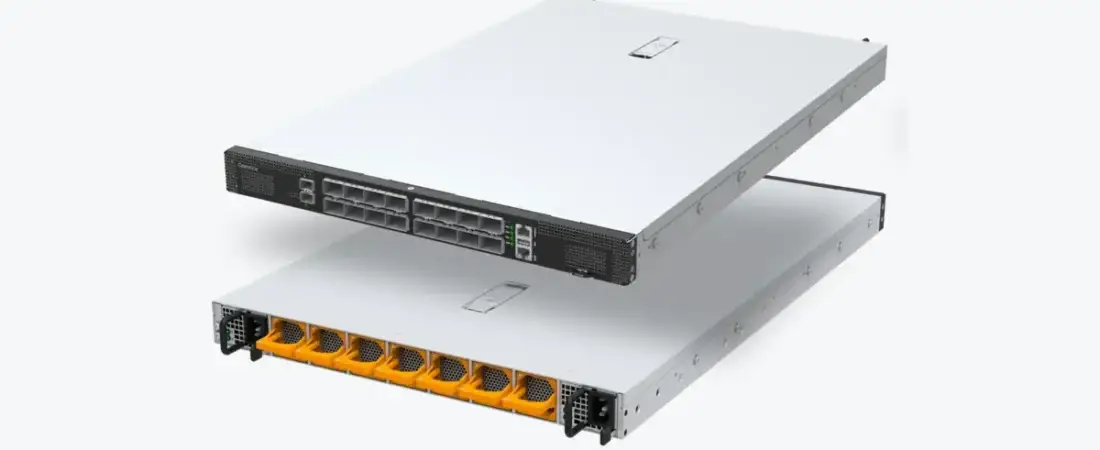
800G Ethernet For AI Data Centers
800G Ethernet is moving from an advanced networking option to an important building block for large AI data centers. GPU clusters are growing from hundreds of accelerators to tens of thousands and beyond, placing a very different type of load on the network than conventional enterprise applications. The challenge is no longer simply moving more bits between servers. AI factory infrastructure needs enormous quantities of data to arrive predictably, with low latency and minimal congestion, because expensive accelerators can spend valuable time waiting when the network falls behind.
For data center managers and infrastructure architects, this makes networking part of the compute-performance equation. Upgrading from 400G to 800G can provide substantially more bandwidth, but port speed alone does not guarantee an efficient AI fabric. Topology, congestion control, RDMA, optics, cabling, telemetry, switch capacity, and power consumption all influence how much useful performance an AI cluster ultimately delivers.
Executive Summary
AI workloads are accelerating the adoption of 800G Ethernet because distributed training and inference generate large volumes of synchronized east-west traffic between accelerators. Unlike many traditional applications, these workloads can become limited by network congestion, latency, or uneven traffic distribution even when aggregate bandwidth appears sufficient.
The industry’s response extends beyond faster interfaces. Vendors including Arista, Cisco, and NVIDIA are combining high-bandwidth Ethernet with congestion management, adaptive routing, telemetry, RDMA, and increasingly specialized AI-networking architectures.
The Ultra Ethernet Consortium is also developing an open, interoperable Ethernet stack for AI and high-performance computing. Its specification addresses transport, congestion control, security, and networking behavior across NICs, switches, optics, and cables.
Meanwhile, the Ethernet Alliance 2026 Roadmap shows the technology cycle advancing toward 1.6T Ethernet. Operators evaluating 800G today must consider current cluster requirements and whether their fiber plant, cooling systems, switch architecture, and operating model can support the next bandwidth transition.
800G Ethernet Speed Comparison
| Interface | Typical Role | Planning Priority |
|---|---|---|
| 400G Ethernet | Current cloud and AI fabrics | Assess whether bandwidth and port density meet near-term cluster growth. |
| 800G Ethernet | High-performance AI scale-out networks | Coordinate topology, RDMA, congestion control, optics, telemetry, power, and cooling. |
| 1.6T Ethernet | Emerging rack-scale and next-generation fabrics | Prepare fiber pathways, switch architecture, rack power, and thermal capacity for migration. |
Five Steps Before Deploying 800G Ethernet
- Measure workload traffic: Model collective communication, east-west bandwidth, latency sensitivity, and acceptable oversubscription.
- Validate the topology: Compare leaf-spine and multiplane designs against cluster size, resilience, cabling, and future growth.
- Test congestion behavior: Verify adaptive routing, RDMA transport, queue management, telemetry, and failure recovery under synchronized loads.
- Model physical infrastructure: Include switch and optics power, airflow, cooling, rack density, fiber pathways, and service access.
- Plan the migration: Confirm that cabling, management tools, and operating procedures can support future 1.6T interfaces.
Why AI Networks Behave Differently
Traditional enterprise networks frequently serve many independent applications generating relatively diverse traffic. AI training produces a different pattern.
Large models are divided across many accelerators working in parallel. Those processors repeatedly exchange gradients, parameters, activations, and other information as the job progresses. Collective operations such as all-reduce can require large numbers of accelerators to communicate before the next computational stage continues.
That creates synchronization.
If one portion of the cluster experiences congestion or excessive latency, other accelerators can be left waiting even though their own computations are complete. Arista describes this characteristic as one reason AI clusters can effectively operate at the speed of their slowest task.
For a conventional application, a brief network slowdown may be almost invisible. In an expensive GPU cluster, repeated delays can reduce accelerator utilization and extend training time.
This is why AI networking discussions increasingly focus on job completion time and compute utilization rather than raw switch throughput alone. Network resilience also belongs in broader data center outage-prevention planning.
What 800G Ethernet Actually Provides
An 800G Ethernet interface can carry up to 800 gigabits per second at the physical Ethernet rate. In practical AI infrastructure, those links can connect servers, SuperNICs, switches, or network tiers depending on the architecture.
Doubling interface speed from 400G to 800G increases available bandwidth per port, which can reduce the number of physical links required for a given amount of network capacity or allow a higher-bandwidth fabric to be built within a similar footprint.
But faster ports do not eliminate oversubscription, congestion, or poor topology design.
If hundreds of accelerators simultaneously send traffic toward the same destination or a small set of network paths, an 800G fabric can still encounter contention. AI network design therefore requires sufficient bandwidth combined with intelligent traffic distribution and congestion management.
For infrastructure leaders, this is the first misconception to avoid: 800G is an important capability, not a complete architecture.
The Leaf-Spine Fabric Remains Important
Leaf-spine architectures have become standard across hyperscale and modern enterprise data centers because they provide predictable paths between servers and support large amounts of east-west traffic.
In a typical design, servers connect to leaf switches, while every leaf connects to a set of spine switches. Traffic between different leaf switches can therefore cross a relatively consistent number of network hops.
AI fabrics take this principle and push it much harder.
Network architects increasingly want shallow topologies because each additional tier introduces switches, optics, cabling, latency, power consumption, and additional points where congestion can develop.
NVIDIA’s Spectrum-X Multiplane architecture, for example, is designed to scale large GPU environments using multiple independent network planes while retaining a shallow two-tier structure. The approach complements NVIDIA’s wider move into powered-site and AI infrastructure development. Arista is similarly developing high-radix platforms intended to increase the number of endpoints that can be supported without continually adding network tiers.
The architectural objective is straightforward: scale the cluster without making the fabric unnecessarily deep.
Congestion Control Becomes A First-Class Requirement
Bandwidth is valuable only when applications can use it.
AI workloads can generate traffic patterns in which many endpoints transmit simultaneously, creating congestion at particular links or destinations. Traditional load balancing may spread flows according to hashes without understanding that several large AI flows have inadvertently been placed on the same path.
Modern AI Ethernet platforms are therefore adding more sophisticated mechanisms.
The NVIDIA Spectrum-X Ethernet platform combines adaptive routing with congestion control and telemetry intended to distribute traffic more effectively. Arista’s AI networking systems similarly emphasize congestion management and high-resolution telemetry. Cisco describes predictable latency, automation, visibility, and high-density 800G and 1.6T connectivity as increasingly important for AI networks.
The common theme is that the network needs to react to actual conditions rather than assuming traffic will distribute itself evenly.
This also increases the operational importance of telemetry. Network teams need visibility into individual flows, queue behavior, packet loss, congestion events, and the relationship between network performance and AI job performance.
RDMA Helps Reduce The Data-Movement Penalty
Remote Direct Memory Access, or RDMA, is another important technology in high-performance AI networking.
RDMA allows data to move between systems with reduced involvement from host CPUs and software stacks. In accelerator-heavy environments, reducing data-movement overhead can improve latency and free processing resources for other work.
RoCE, or RDMA over Converged Ethernet, has become widely associated with Ethernet-based AI fabrics. It can deliver high-performance data transfer, but the network needs to be engineered carefully because congestion and packet loss can significantly affect performance.
The Ultra Ethernet Consortium is pursuing a broader approach through Ultra Ethernet Transport, or UET. Its specification defines an Ethernet-based transport designed specifically around AI and HPC requirements, including mechanisms addressing congestion, reliability, scalability, and interoperability.
The initial UEC Specification 1.0 was released in June 2025, and the consortium published version 1.0.3 in July 2026.
For buyers, UEC matters because it represents an industry attempt to preserve Ethernet’s open ecosystem while adapting the technology to workloads traditionally associated with specialized high-performance interconnects.
Ethernet Versus InfiniBand Is No Longer A Simple Choice
InfiniBand has established a strong position in large AI and HPC environments because of its low latency, mature RDMA capabilities, and tightly integrated approach to high-performance networking.
Ethernet brings different advantages. Enterprises and cloud providers have decades of Ethernet operating experience, broad vendor ecosystems, standardized tooling, and substantial existing investment in networking skills and infrastructure.
The market is therefore not simply choosing between conventional Ethernet and InfiniBand.
Ethernet itself is changing.
Spectrum-X, Arista Etherlink, Cisco’s AI networking portfolio, and the Ultra Ethernet initiative are examples of the industry adding capabilities intended to make Ethernet more predictable under synchronized AI traffic.
For CIOs, the decision should be workload-driven. Existing expertise, vendor strategy, cluster scale, interoperability requirements, operating model, performance objectives, and total cost all matter.
A technology winning a benchmark does not automatically make it the right network for every organization.
Optics Become A Major Cost And Power Issue
Faster networking creates a physical infrastructure problem.
An AI cluster can require thousands of high-speed links. At 800G, the optical modules, fiber, connectors, and associated switch interfaces become significant contributors to capital cost and energy consumption.
The Ethernet Alliance’s 2026 roadmap specifically identifies bandwidth-per-watt and next-generation optical technologies as important parts of Ethernet’s evolution.
Several approaches are being developed to reduce power.
Linear Pluggable Optics, or LPO, simplify portions of the optical signal-processing chain with the goal of reducing power and latency. Arista says some of its next-generation platforms using LPO options can substantially lower network power consumption.
Co-packaged optics move optical components closer to the switch silicon. NVIDIA is developing silicon-photonics-based Spectrum-X systems that integrate optical technology more closely with the switch ASIC, targeting improved energy efficiency and reliability.
These technologies matter because network power is becoming harder to dismiss as a small fraction of the overall data center load. Every watt consumed by switching and optics is a watt that cannot be assigned to accelerators within a fixed facility power envelope.
Cabling Decisions Need A Longer Time Horizon
800G Ethernet also changes physical-layer planning.
Short-reach connections may use copper, while longer distances generally require optical connectivity. The appropriate choice depends on distance, density, power, cost, equipment layout, and the particular interface standard.
Data center operators should avoid designing the cable plant only around today’s switch generation.
The Ethernet Alliance’s roadmap already extends into 1.6T Ethernet, and the industry is developing 200Gb/s-per-lane signaling technologies that can support future 800G and 1.6T interfaces.
Replacing switches during a technology refresh is expected. Reworking large amounts of structured fiber inside an operating AI facility can be considerably more disruptive.
Infrastructure architects should therefore evaluate fiber type, connector strategy, pathway capacity, rack layouts, patching, and future optical requirements before deploying large quantities of 800G connectivity.
800G Changes Network Power And Cooling
Network design is becoming increasingly connected to facility engineering.
Higher-radix switches processing tens or hundreds of terabits per second generate significant heat. Dense racks containing accelerators, NICs, switches, and optical modules increase both electrical and thermal loads.
Arista’s next-generation 1.6T portfolio illustrates the direction of travel. The company has announced both air-cooled and liquid-cooled switch configurations for future rack-scale AI infrastructure.
That is a meaningful development for data center managers. Liquid cooling discussions have generally concentrated on GPUs and CPUs, but networking equipment may increasingly become part of the high-density thermal design.
Facility and network teams therefore need to coordinate rack layouts, airflow, coolant distribution, cable routing, power feeds, serviceability, and equipment replacement procedures. These requirements should be included during data center site selection and infrastructure planning, not added after the network design is finalized.
The network can no longer always be treated as a low-density layer around much hotter compute infrastructure.
Operations Matter As Much As Architecture
A large 800G fabric can be technically impressive and operationally difficult.
Thousands of ports, optical modules, cables, NICs, switches, and software components create many possible failure points. AI workloads can also make subtle problems visible because a degraded link may affect collective communication and reduce performance without producing a complete network outage.
Deep telemetry therefore becomes essential.
Operators need to distinguish between a compute bottleneck and a network bottleneck quickly. They should be able to identify failing optics, excessive retransmissions, congested paths, abnormal latency, queue pressure, and imbalanced traffic without manually examining every device.
Automation also becomes more valuable as cluster size increases. Configuration consistency, automated validation, intent-based changes, and rapid rollback can reduce the operational risk associated with very large fabrics.
For infrastructure leaders, staffing belongs in the architecture discussion. Deploying AI networking technologies without developing the skills required to operate them can turn technical sophistication into operational fragility.
The Transition To 1.6T Has Already Started
Organizations deploying 800G in 2026 are doing so while the next generation is already appearing.
The Ethernet Alliance’s current roadmap includes emerging 1.6Tb/s Ethernet, while vendors are introducing the first 1.6T-capable platforms. In June 2026, Arista announced its 7060XE7 family with 1.6T port configurations and a migration path from 800G, with availability beginning in late 2026 and continuing into 2027.
This does not make 800G obsolete.
Instead, it demonstrates the pace of the AI networking cycle. 800G can serve as a practical high-performance interface while 1.6T begins appearing at the highest end of rack-scale and scale-out infrastructure.
The more important question is whether today’s architecture provides a migration path.
Switch chassis, fiber, rack power, cooling, management software, and topology choices should be evaluated against that future rather than assuming 800G represents an endpoint.
What Infrastructure Leaders Should Evaluate
Before committing to an 800G Ethernet architecture, decision-makers should assess:
- the number of accelerators and expected growth of the cluster;
- actual east-west bandwidth requirements for training and inference workloads;
- acceptable levels of oversubscription;
- leaf-spine or multiplane topology requirements;
- RDMA and transport strategy, including RoCE or emerging UET options;
- congestion-control and adaptive-routing capabilities;
- switch, NIC, optics, and cabling interoperability;
- telemetry and automated troubleshooting capabilities;
- network power consumption and cooling requirements;
- fiber infrastructure needed for future 1.6T migration; and
- the operational skills required to manage the fabric reliably.
The objective should not be to deploy the highest available port speed everywhere. It should be to build a network that keeps expensive computing resources productive while remaining operationally and economically sustainable.
Future Outlook
AI networking is likely to become faster, flatter, more automated, and more tightly integrated with compute infrastructure.
800G Ethernet is an important stage in that transition, but the larger change is architectural. Ethernet is being adapted for workloads where congestion, tail latency, flow distribution, and collective communication can directly affect the utilization of thousands of accelerators.
UEC provides one route toward a more open, interoperable AI Ethernet ecosystem. Vendor-specific innovations are advancing in parallel, while 1.6T interfaces, new optical technologies, and increasingly integrated rack-scale systems are moving into the market.
The pressure on network teams will continue to increase because accelerator performance is advancing quickly. Every new compute generation creates more data that must move between devices without turning the network into the limiting resource.
Frequently Asked Questions
What Is 800G Ethernet?
800G Ethernet refers to Ethernet connectivity supporting an aggregate physical data rate of 800 gigabits per second per interface. It is increasingly used for high-performance cloud and AI networking where large amounts of east-west bandwidth are required.
Why Do AI Data Centers Need 800G Ethernet?
Large AI clusters distribute work across many accelerators that frequently exchange data. Higher-speed networking can reduce communication bottlenecks, but effective AI fabrics also require appropriate topology, congestion control, RDMA, telemetry, and sufficient switching capacity.
Will 1.6T Ethernet Replace 800G?
1.6T Ethernet is beginning to emerge for the next generation of high-density AI infrastructure, but 800G will remain relevant during the transition. Operators should focus on whether today’s 800G architecture provides a practical upgrade path to higher-speed interfaces.
Is Ethernet Better Than InfiniBand For AI?
Neither technology is universally superior for every deployment. InfiniBand has a strong history in high-performance computing and AI, while Ethernet offers a broad ecosystem, established operational skills, and rapidly advancing AI-specific capabilities. The appropriate choice depends on workload, scale, performance requirements, interoperability, cost, and operational strategy.
Conclusion
800G Ethernet matters because AI has changed what data center networks are being asked to do.
The network is no longer merely transporting application traffic between servers. In a large AI cluster, it participates directly in the performance of a distributed computing system. Congestion, latency, optics, topology, and failed links can translate into idle accelerators and longer job completion times.
That makes the most important investment decision larger than choosing an 800G switch.
Infrastructure leaders need to design the fabric, optics, cabling, telemetry, power, cooling, and operating model as one system—and they need to do so while preparing for 1.6T.
For AI data centers, faster Ethernet is only valuable when the rest of the architecture can keep up.