
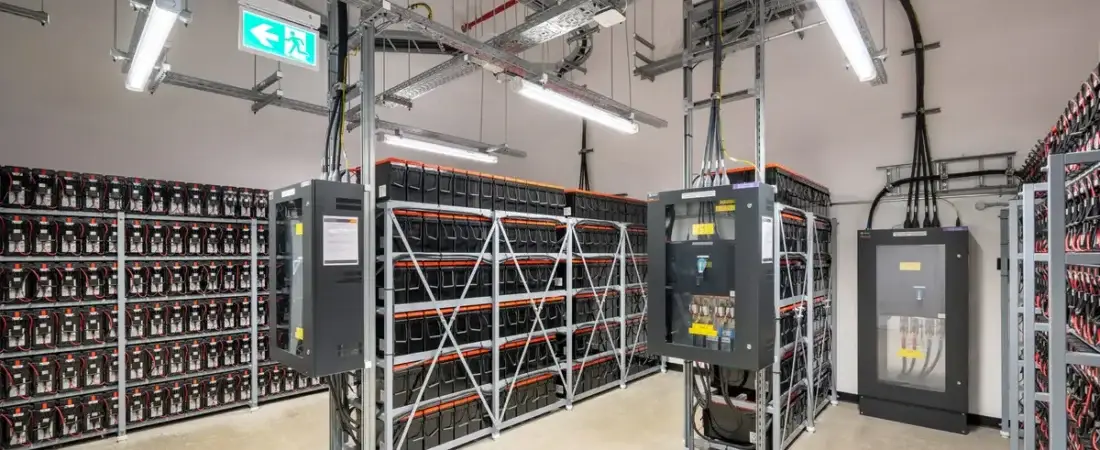
AI data center microgrids are moving from a resilience concept into a practical power strategy. As hyperscale and high-density facilities demand hundreds of megawatts and grid connection queues stretch into years, operators are combining utility power, onsite generation, battery energy storage, UPS systems, and intelligent controls to secure capacity sooner and operate it more flexibly.
A microgrid can reduce dependence on one utility connection, support critical loads during disturbances, smooth changing AI demand, and participate in grid-services markets. However, it is not simply a collection of generators and batteries. Protection, controls, fuel supply, switching, synchronization, and operating procedures must function as one electrical system.
Executive Summary
Data center microgrids coordinate resources that may include the utility grid, natural-gas generation, renewables, battery energy storage systems, UPS infrastructure, fuel cells, and backup generators. A microgrid controller decides when each resource operates.
In grid-connected mode, the system can manage peak demand, battery charging, power quality, and energy costs. During a grid failure, an appropriately designed microgrid can island from the utility and continue supporting selected loads.
ABB’s microgrid-ready medium-voltage architecture integrates battery storage, gas turbines, renewables, peak shaving, and grid support. Eaton describes a similar integrated strategy combining onsite generation, BESS, and grid-interactive UPS systems.
Why AI Data Center Microgrids Are Becoming Critical
Traditional data center design treats the utility as the primary source, UPS systems as short-duration bridges, and generators as longer-duration backup. AI is testing that model at much larger scales.
GPU clusters create large continuous loads and can produce rapid changes in demand. A utility may have sufficient regional generation but lack the transmission, substation, or interconnection capacity required to serve a new campus on the developer’s timetable. Waiting years for upgrades can be commercially unacceptable.
The central question is shifting from “How do we back up the grid?” to “How do we assemble enough dependable power from several sources to operate the facility?”
What an AI Data Center Microgrid Does
A microgrid is a locally controlled network coordinating distributed energy resources and loads within a defined boundary. It may normally operate in parallel with the utility, with batteries and onsite generation responding to economic or operational conditions.
Batteries can discharge to reduce peak demand. During grid instability, storage and generation may support the facility. If utility service fails, an island-capable system can disconnect and maintain selected loads.
Coordination is the defining feature. Independent generators and UPS units do not automatically create a microgrid. Controls must understand the state of the grid, generation, batteries, loads, breakers, and protection systems and make safe decisions about their interaction.
BESS and UPS Roles Are Expanding
Battery energy storage systems are becoming central to modern microgrids. Traditional UPS batteries primarily provide ride-through until generators start. A dedicated BESS can buffer rapid AI load changes, stabilize power, support peak shaving, and participate in demand response.
This makes battery assets productive during normal operation, but resilience must remain the priority. Grid-services revenue is useful only if dispatch does not compromise stored energy, battery health, or readiness for critical IT loads.
The boundary between UPS and BESS is also becoming less rigid. ABB’s HiPerGuard architecture combines medium-voltage UPS capability with battery storage and microgrid controls. Operators must decide whether batteries remain dedicated backup assets or participate actively in the energy strategy.
The answer depends on chemistry, redundancy, warranties, grid requirements, and risk tolerance. Controls must preserve sufficient reserve for ride-through even when batteries are used to reduce demand charges.
Onsite Generation Can Improve Speed-to-Power
Natural-gas engines and turbines can provide firm power independently of utility expansion. Fuel cells are another option, while renewable generation can contribute where land, weather, and economics permit.
For large campuses, onsite power may bridge the period until full grid capacity arrives or remain a permanent resource. That can make a constrained site commercially viable, but it shifts responsibilities to the operator or energy partner.
Fuel contracts, emissions permits, maintenance, spare parts, noise, air quality, and generation reliability become operational concerns. Onsite megawatts are not automatically equivalent to power from a robust utility network; the complete lifecycle and resilience model matters.
Islanding and Black Start Require Careful Engineering
When connected to a large utility, the grid establishes voltage and frequency. After separation, the microgrid must maintain those conditions itself. Generation and storage need grid-forming or stabilizing capability, while protection schemes must work under different fault-current conditions.
Loads may need to be prioritized or shed if available generation cannot support the entire campus. Reconnection is equally important: voltage, frequency, and phase must be synchronized before closing the intertie.
Black start allows electrical infrastructure to restart when neither the utility nor internal system is energized. Batteries can energize controls, switchgear, buses, and equipment needed to start generation. Restoration must follow an engineered sequence because transformers, UPS systems, pumps, cooling equipment, and IT loads cannot necessarily return simultaneously.
Microgrid Controls Become Mission-Critical Software
The controller monitors utility conditions, generator output, fuel availability, battery charge, UPS status, breaker states, renewables, and facility load. It may decide when to charge or discharge storage, start generation, reduce grid demand, or preserve reserve capacity.
This introduces software and communications risk into the power chain. Cybersecurity, validation, fail-safe behavior, and change management therefore become infrastructure requirements. A controller failure must not turn otherwise healthy equipment into a site-wide outage.
Grid-Interactive Operation Creates New Value
Vertiv and CPower’s 2026 collaboration connects behind-the-meter storage with a virtual power plant platform. The goal is to let data center energy assets provide demand response and other grid services while supporting resilience and interconnection strategies.
Flexible storage and generation can let data centers behave as controllable grid assets rather than only large consumers. Participation must still protect the primary mission and comply with utility rules, telemetry requirements, and interconnection agreements.
The Economics Extend Beyond Backup Power
A microgrid can require significant investment in batteries, generation, switchgear, controls, and fuel infrastructure. The business case should consider avoided outages, earlier energization, peak-demand savings, grid-services revenue, deferred upgrades, energy optimization, and resilience.
Speed-to-power can be especially valuable. If onsite resources let a revenue-producing AI campus open years earlier, accelerated deployment may justify higher energy costs. Conversely, a complex system can become unnecessary expense where reliable utility capacity is readily available.
Microgrids should solve a defined infrastructure constraint rather than become a technology objective. Evaluation should connect with power-led site selection, large-load electricity tariffs, outage prevention, AI cooling dependencies, and the foundational microgrid architecture guide.
12 Critical AI Data Center Microgrid Decisions
Infrastructure leaders should answer these questions before design approval:
- What grid capacity is available now, and when will more arrive?
- Which loads must remain energized during island operation?
- How much storage is required for ride-through, grid services, and black start?
- Which onsite generation technology fits the load profile?
- How resilient is the fuel supply?
- Can transitions occur without interrupting critical IT?
- How will UPS and BESS responsibilities be coordinated?
- Which protection, synchronization, and grid-code rules apply?
- How will controls be secured, tested, and changed?
- Which savings or revenue justify the capital cost?
- Who operates and maintains the energy assets?
- What happens if the controller fails?
Natural Gas and Renewables Require Different Safeguards
Natural-gas generation is attractive because it can deliver dispatchable power at large scale and operate independently of weather. For developers facing long grid queues, that capability can support phased energization. However, gas creates dependencies on pipeline capacity, fuel contracts, emissions permits, maintenance, noise limits, and air-quality requirements. Operators must distinguish emergency generators that run infrequently from primary generation expected to operate for thousands of hours each year, because their regulatory and maintenance obligations can differ substantially.
Solar and wind can reduce the carbon intensity of an AI data center microgrid, but neither provides firm capacity on demand without supporting resources. Batteries can shift renewable energy and smooth short-duration variability, while extended periods of low production may still require utility imports or dispatchable generation.
A resilient low-carbon design is therefore usually a portfolio. Grid power, renewables, storage, and firm generation should be coordinated according to availability, emissions, operating cost, and workload requirements. The controller must preserve critical-load reserves while optimizing normal operations, and the commercial model should test fuel-price, battery-degradation, and renewable-output scenarios before investment approval under realistic worst-case operating conditions for long-term operational resilience.
AI Data Center Microgrids: Frequently Asked Questions
Can a microgrid replace the utility grid?
It can support independent operation when designed with sufficient generation, storage, fuel, controls, and redundancy. Most data center microgrids complement rather than permanently replace utility service.
What is the role of BESS?
A BESS can provide rapid response, smooth AI demand, support islanding and black start, reduce peaks, and participate in grid-service markets. Its exact role depends on the site’s resilience and commercial strategy.
Can microgrids reduce diesel-generator use?
Potentially. Batteries, gas generation, fuel cells, and renewables can reduce diesel dependence, but the appropriate design depends on runtime, emissions rules, fuel availability, cost, and reliability objectives.
Conclusion
AI data center microgrids address a changing power problem. Developers need large quantities of electricity, dynamic-load support, resilience, and capacity that may be available before conventional grid infrastructure is ready.
A microgrid can help only when batteries, UPS systems, generation, grid connections, protection, controls, and operating procedures are engineered together. The decisive question is whether the architecture provides a more reliable, faster, and economically defensible route to usable power.