Brownfield Data Center Expansion: 15 Critical AI Retrofit Checks
Brownfield data center expansion is becoming a more important strategy as AI demand grows faster than operators can build new campuses. Existing facilities already possess assets that are increasingly difficult to secure: land, grid connections, fiber, permits, operating staff, and functioning electrical and mechanical infrastructure. When enough of that foundation can be reused, retrofitting an existing site may bring AI capacity online faster than developing an empty parcel.
The economics are not automatic. A legacy facility designed around 10kW or 20kW racks can encounter serious constraints when supporting liquid-cooled AI systems exceeding 100kW per rack. Electrical headroom, transformers, UPS systems, floor loading, pipe routes, water temperatures, structural limits, and commissioning requirements can turn an apparently simple upgrade into major reconstruction.
For CIOs, CTOs, and operators, the key question is not whether an existing building can physically accommodate new servers. It is whether enough critical infrastructure can be reused safely and economically to justify expansion.
Why Brownfield Data Center Expansion Is Attractive
The strongest advantage of an operating site is that difficult development work may already be complete. It may have a grid connection, substation, transformers, fiber routes, security, roads, staff, permits, generators, and cooling equipment. Reusing those assets can remove years from a project compared with securing and constructing a greenfield campus.
Power makes that head start especially valuable. A site with deliverable electrical headroom today may be worth more than a larger location waiting years for utility upgrades. Brownfield development can also reduce uncertainty because the operator understands local weather, utility behavior, maintenance history, staffing conditions, and regulatory requirements.
However, retained equipment must suit the intended workload. The objective is not to preserve the greatest possible amount of legacy infrastructure. It is to identify which assets still improve the new system’s schedule, reliability, and lifecycle economics.
Start With the Complete Power Path
The first assessment should usually be electrical. AI racks can require many times the power density of the equipment they replace. A hall may contain abundant floor space while lacking enough usable electrical capacity to make that space commercially valuable.
Operators should trace the complete path from utility supply through substations, transformers, switchgear, UPS systems, busway or power distribution units, and rack connections. A bottleneck anywhere can limit the retrofit. A transformer may appear adequate until cooling and facility loads are included, while legacy switchgear or busway may be unable to carry the required current.
The meaningful metric is therefore not total site megawatts. It is resilient megawatts deliverable to the intended racks. This same distinction is central to modern data center site selection and power availability.
UPS Architecture Can Restrict AI Clusters
A legacy site may have sufficient total UPS capacity but in electrical blocks that do not align with dense AI clusters. One rack can consume as much power as several rows of conventional enterprise systems, producing awkward loading patterns and larger failure domains.
Operators may need additional UPS modules, redesigned distribution, new transfer equipment, or higher distribution voltages. Maintenance matters too. If upgrades require extended shutdowns or leave production equipment without redundancy, the schedule advantage of reuse can disappear. The design must consider normal operation, component failure, maintenance states, and future expansion—not merely nameplate capacity.
Liquid Cooling Is Often the Turning Point
Cooling frequently determines whether a brownfield AI project is practical. Schneider Electric’s brownfield modernization guidance explains how liquid cooling can unlock higher rack density, while emphasizing that every facility is not a suitable candidate.
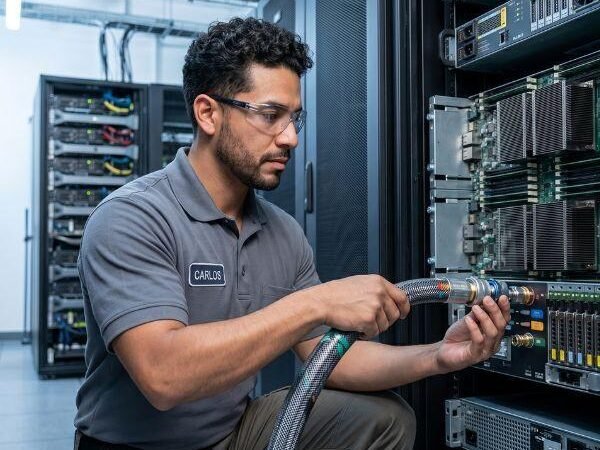
Direct-to-chip systems transfer much of the processor heat into a liquid loop rather than relying entirely on room air. This supports much denser equipment without proportional airflow growth. Yet installing liquid cooling involves more than adding a coolant distribution unit. The facility needs pipe routes, CDU locations, pumps, heat exchangers, isolation valves, leak detection, controls, maintenance access, and suitable water chemistry.
The existing chilled-water system may also operate at temperatures or flow rates incompatible with the technology cooling loop. Operators evaluating this transition can use the practical checks in our direct-to-chip cooling guide.
The Cooling Plant Must Reject Every Kilowatt
Liquid cooling changes how heat moves through a building; it does not eliminate heat. Converting from conventional air cooling can reduce the burden on computer-room air equipment while transferring more energy into the facility water system.
Engineers must assess chillers, cooling towers, dry coolers, pumps, heat exchangers, and distribution pipework. A site can have spare electrical capacity but inadequate heat rejection, requiring mechanical expansion before additional IT load is commissioned. Power and cooling calculations therefore need to be performed together under expected peak conditions and credible failure scenarios.
Structural Capacity and Equipment Routes Matter
AI racks can be significantly heavier than the systems they replace. Accelerators, power shelves, switches, cooling manifolds, and dense cabling increase weight, while CDUs and overhead piping add more loads. Raised floors, slabs, platforms, and roof areas supporting cooling equipment require engineering review.
The assessment must also follow the delivery route. Loading docks, elevators, corridors, door openings, ramps, and temporary lifting arrangements can constrain equipment movement through buildings designed for smaller servers. A rack that is safe in its final position still has to reach the hall without damaging the facility or interrupting operations.
Live-Site Construction Raises Operational Risk
Brownfield work frequently occurs inside or beside an operating data center. Technicians may modify switchgear, install piping, open ceilings, or change controls near production systems. Every task introduces potential risk.
Methods of procedure, change control, isolation plans, temporary protection, contamination controls, and contractor supervision are essential. Sequencing should minimize occasions when production infrastructure operates with reduced redundancy. The fastest retrofit is not necessarily the project with the shortest construction schedule; it is the one that reaches production without causing an outage.
IREN Shows What Large-Scale Conversion Requires
IREN’s transition from Bitcoin mining toward AI cloud services illustrates infrastructure reuse at scale. The company reported approximately 40MW of operating AI cloud capacity at June 30, 2026 while reallocating power and facilities toward AI workloads.
At Childress, Texas, IREN delivered Horizon 1, a 50MW direct-to-chip liquid-cooled deployment for Microsoft, in August 2026. Three additional 50MW phases were in commissioning or construction. The change involves far more than replacing servers: the company has reported impairments associated with decommissioning mining hardware while investing in new cooling, networking, buildings, and compute infrastructure.
The lesson is that existing power can provide a valuable head start without making conversion inexpensive. Mining sites may offer land and grid-connected capacity, but AI services demand higher resilience, sophisticated cooling, fast networks, secure buildings, and mature operations.
Fifteen Checks Before Approving a Retrofit
| Check |
|---|
| Confirm usable IT power after facility loads and resilience margins. |
| Identify transformer, switchgear, UPS, and distribution bottlenecks. |
| Model the new load profile during normal and failure conditions. |
| Define the proportion of heat captured by liquid cooling. |
| Verify water temperatures, flow rates, chemistry, and pressure. |
- Confirm available heat-rejection capacity in peak weather.
- Reserve safe routes and service space for pipes and CDUs.
- Validate slab, floor, roof, and equipment-platform loads.
- Check loading docks, elevators, corridors, and lifting routes.
- Assess internal fabric bandwidth and external fiber diversity.
- Integrate thermal, electrical, and rack telemetry.
- Sequence construction around live workloads and maintenance.
- Commission retained and new systems together.
- Compare retrofit capital and disruption with greenfield alternatives.
- Test whether the design can support the next hardware generation.
When Building New May Be Better
Retrofitting becomes less attractive when fundamental systems require replacement. If a project needs new utility service, transformers, UPS architecture, structural strengthening, liquid-cooling loops, heat rejection, fiber, and extensive live-site work, the operator may effectively be constructing a new data center inside an old shell.
Lifecycle operations can be simpler. Decision-makers should compare whole-system cost, delivery risk, usable capacity, and future adaptability rather than treating previously spent capital as a reason to retain unsuitable equipment.
Frequently Asked Questions
What is brownfield data center expansion?
It is the modernization or enlargement of an existing data center to support additional capacity or new technology instead of constructing an entirely new facility.
Can existing data centers support AI racks?
Many can, but suitability depends on power, cooling, structure, networking, controls, layout, and operational risk. Dense AI systems commonly require liquid cooling and substantial electrical upgrades.
Is retrofitting faster than building a new data center?
It can be faster when useful power, fiber, buildings, permits, and infrastructure already exist. The advantage shrinks when most critical systems need replacement.
Conclusion
A phased pilot can reduce uncertainty before successful full deployment. Operators should validate one representative rack group, measure electrical and thermal performance, test maintenance procedures, and use commissioning evidence to refine capacity models, budgets, schedules, and operational training plans.
Brownfield data center expansion can provide a fast route to AI capacity when an existing facility contains infrastructure worth preserving. Power connections, substations, fiber, permits, and buildings offer a major head start, while liquid cooling can extend the commercial life of sites designed for earlier workloads.
Retrofitting becomes a false economy when too many critical systems are already at their limits. The correct question is not whether an old facility can be forced to support AI. With enough money, many can. The better question is whether reused assets create a safer, faster, and more economical platform than a purpose-built alternative.