
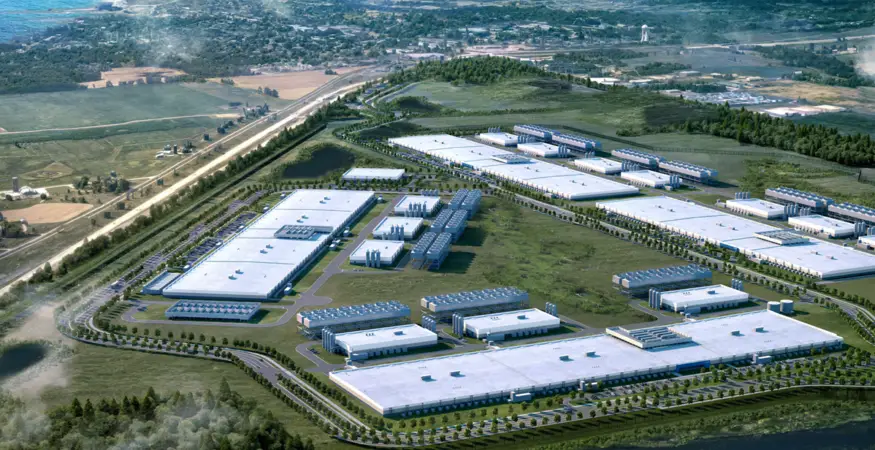
NVIDIA has taken a minority stake in Cloverleaf Infrastructure as part of a strategic partnership intended to accelerate AI data center development across the United States. The NVIDIA Cloverleaf investment extends the chipmaker’s infrastructure strategy beyond GPUs and networking into one of the industry’s most difficult constraints: finding and developing sites where enough power, cooling, and physical infrastructure can actually be delivered.
Cloverleaf announced the partnership on August 21. Financial terms and the size of NVIDIA’s minority investment were not disclosed.
According to Cloverleaf’s official partnership announcement, the companies will combine powered-site development expertise with NVIDIA’s AI infrastructure technology, including the NVIDIA DSX platform. The NVIDIA Cloverleaf investment is intended to bring decisions about land, electricity, cooling, computing, and facility design together earlier in development.
Executive Summary
NVIDIA has made a minority investment in Cloverleaf Infrastructure, a U.S. developer focused on delivering powered and shovel-ready sites for data center customers.
Cloverleaf says it has advanced a development pipeline that includes multiple gigawatt-scale projects across North America since the company was formed in 2024.
Under the partnership, Cloverleaf will use NVIDIA DSX to help customers evaluate power, water, cooling, compute, and facility trade-offs before an AI factory is built. Once facilities become operational, NVIDIA infrastructure and software are intended to help customers optimize energy use and computing capacity.
The strategic significance is larger than the undisclosed equity investment. NVIDIA is increasingly treating the physical infrastructure required to house and energize its computing systems as part of the AI supply chain.
NVIDIA Moves Further Upstream
NVIDIA’s traditional position in the data center centered on accelerated computing. Its GPUs became the foundation of large AI training and inference clusters, while technologies such as NVLink, InfiniBand, Spectrum-X Ethernet, and associated software expanded the company’s role across the computing stack.
The constraint facing customers is now broader.
Organizations can secure financing and develop plans for large GPU clusters but still struggle to obtain sites capable of supporting them. Multi-hundred-megawatt and gigawatt-scale AI facilities require suitable land, utility connections, transmission capacity, cooling infrastructure, network connectivity, construction resources, and lengthy permitting processes.
NVIDIA is increasingly treating those resources as strategically important to selling compute.
In an August 17 discussion of its infrastructure strategy, NVIDIA CEO Jensen Huang described land, power, and shell capacity as a critical resource for AI factories. That approach is also visible in NVIDIA’s involvement with the OpenAI PORTS-Pike data center project. The NVIDIA Cloverleaf investment puts the strategy into practice through a developer specializing in the earliest stages of data center infrastructure.
Why Powered Land Has Become So Valuable
The phrase “powered land” can make the development problem sound simpler than it is.
A suitable data center site needs more than a large parcel near a transmission line. As explained in our guide to data center site selection and power availability, developers must establish how much electricity can be delivered, when it will become available, which grid upgrades are required, who will finance them, and whether the surrounding infrastructure can support later expansion.
Those questions have become more difficult as proposed AI campuses move toward gigawatt scale.
Power availability can now determine the commercial schedule of an AI deployment. A developer may control land and have a prospective customer, but a multi-year wait for grid interconnection can prevent that land from becoming revenue-producing data center capacity.
Cloverleaf’s business is positioned around that gap. The company works with utilities, energy providers, investors, and technology customers to develop sites capable of supporting large computing loads. Some campuses may also evaluate data center microgrids and onsite power architectures when conventional grid delivery cannot meet their schedule.
DSX Connects Compute With Facility Design
The technical element of the partnership is NVIDIA DSX.
Cloverleaf says it will apply the platform to bring decisions about site infrastructure, power, cooling, computing, and facilities together earlier in the design process. Customers will be able to assess infrastructure trade-offs with the objective of generating more useful AI output within the available power, water, and grid constraints.
This represents an important change in how data centers can be designed.
Historically, a facility might be developed around a defined amount of IT capacity before customers populated it with servers and networking equipment. High-density AI factory infrastructure makes that separation increasingly difficult.
The characteristics of the compute influence electrical distribution, cooling architecture, rack design, network topology, and ultimately the amount of useful computing that can be extracted from every available megawatt.
Designing the building and computing platform together can therefore become a competitive advantage.
The Megawatt Is Becoming A Computing Metric
The NVIDIA Cloverleaf investment also reflects a change in how AI infrastructure economics are being discussed.
For conventional data center capacity, megawatts largely describe the amount of IT load a facility can support. In an AI factory, the more commercially relevant question is how much useful computing output can be generated from those megawatts.
Two facilities with identical power allocations may produce different results depending on accelerator generation, networking, cooling efficiency, utilization, software, and workload orchestration.
That means optimizing the electrical system without considering the computing architecture can leave valuable capacity unused. Conversely, deploying increasingly dense computing equipment without designing suitable power and cooling infrastructure can create operational bottlenecks.
NVIDIA’s strategy attempts to connect those layers.
Why This Matters For Data Center Developers
For developers, the partnership signals that technology vendors may become more deeply involved in decisions traditionally handled by real estate, utilities, engineering companies, and data center operators.
That can change development timelines.
If the eventual compute architecture is understood earlier, developers can make more informed decisions about electrical systems, cooling technologies, network infrastructure, building layouts, and expansion phases before construction is substantially advanced.
It may also reduce the risk of developing capacity that proves difficult to adapt to future high-density systems.
The trade-off is greater interdependence between the facility and technology platform. Data centers are long-lived assets, while accelerator and networking generations move much faster. Developers therefore need to ensure that infrastructure optimized for today’s AI systems can accommodate later generations without expensive reconstruction.
NVIDIA Is Building An Infrastructure Ecosystem
The Cloverleaf agreement should also be viewed alongside NVIDIA’s broader AI infrastructure strategy.
NVIDIA said earlier in August that it is working with Apollo, BlackRock, Blackstone, Brookfield, Goldman Sachs, and KKR on independent financing platforms intended to mobilize more than $500 billion of third-party capital for AI infrastructure over time.
The company has also become involved in securing land, power, and shell capacity for major AI developments. Similar infrastructure coordination is visible in Amazon’s $18 billion Louisiana data center expansion, where grid and water investments form part of the development program.
These moves suggest NVIDIA increasingly sees infrastructure availability as directly connected to future accelerator demand.
There is a straightforward commercial logic. A GPU that cannot be powered does not generate useful compute. Helping customers overcome power, financing, construction, and site constraints can therefore expand the addressable market for the computing hardware itself.
5 Strategic Gains From The NVIDIA Cloverleaf Investment
The NVIDIA Cloverleaf investment can create five practical advantages for infrastructure developers and AI customers:
- Earlier power validation: Teams can test utility capacity, interconnection schedules, and grid-upgrade requirements before major construction commitments.
- Integrated facility design: NVIDIA DSX can align compute density with electrical distribution, cooling, networking, and building layouts.
- Faster deployment decisions: Customers can compare powered sites using clearer assumptions about available megawatts, water, permits, and expansion phases.
- Better output per megawatt: Co-designing facilities and computing systems can help operators convert constrained power into more useful AI capacity.
- Reduced retrofit risk: Planning the technology and physical infrastructure together can limit expensive changes after construction begins.
These gains are not automatic. Developers should still verify power-delivery dates, permits, financing, equipment lead times, and the flexibility required for future accelerator generations.
What Happens Next
Cloverleaf will now use the partnership and NVIDIA’s technology across its development pipeline as it works with customers and utility partners on new AI infrastructure.
The company has not disclosed individual projects tied specifically to NVIDIA’s investment, nor has either party disclosed the size or valuation associated with the minority stake.
Those omissions are important. The announcement establishes a strategic relationship, but it should not be interpreted as confirmation that every project in Cloverleaf’s pipeline will become an NVIDIA AI factory or that all proposed gigawatt-scale capacity will ultimately be built.
The broader direction, however, is clear.
AI infrastructure competition is moving upstream. Silicon remains critical, but so do the sites, substations, transmission systems, cooling plants, buildings, and financing required to turn silicon into operating compute.
Frequently Asked Questions
What Is The NVIDIA Cloverleaf Investment?
The NVIDIA Cloverleaf investment is a minority equity stake and strategic partnership designed to accelerate powered-site and AI factory development across the United States. The companies did not disclose the financial terms.
How Will Cloverleaf Use NVIDIA DSX?
Cloverleaf plans to use NVIDIA DSX during site and facility planning to evaluate trade-offs involving power, water, cooling, compute, and grid constraints. Customers can then use NVIDIA infrastructure and software to optimize operations after facilities open.
Why Does Powered Land Matter For AI Data Centers?
Powered land combines a suitable site with a credible path to electricity, grid connections, permits, cooling, and future expansion. Without those elements, financing and GPU availability cannot turn a proposed campus into operating AI capacity.
Conclusion
NVIDIA’s investment in Cloverleaf is relatively modest in disclosed detail: it is a minority stake whose financial terms remain private. Strategically, it says considerably more.
The company that became central to the AI boom through accelerated computing is now helping address the physical constraints that determine whether those accelerators can be deployed.
For data center executives, that is the important signal. The boundary between technology procurement and infrastructure development is becoming less distinct.
In the next phase of AI expansion, securing GPUs will not be enough. The organizations capable of coordinating compute, land, electricity, cooling, networking, capital, and construction may determine how quickly those GPUs can become productive infrastructure.