Modular Data Centers: Faster AI Capacity, Real Limits
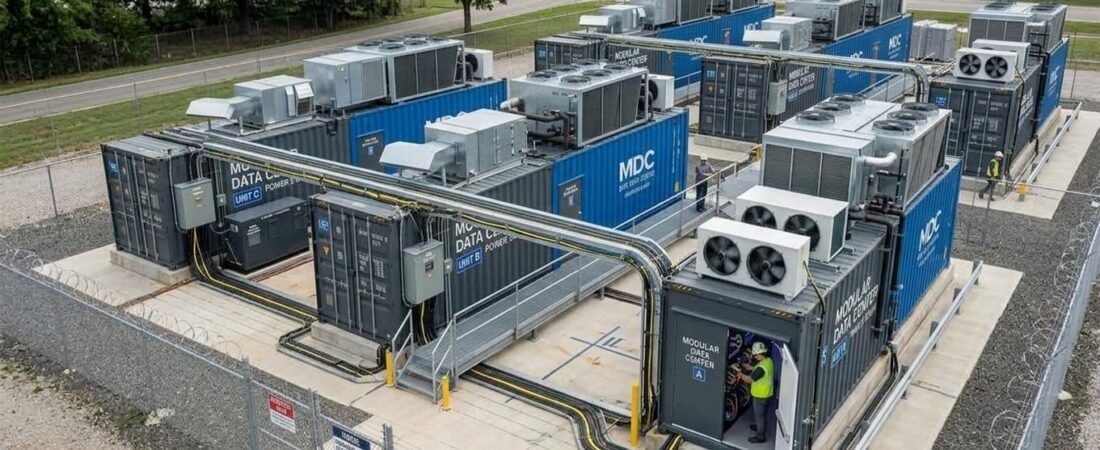
Modular data centers are becoming a more important deployment strategy as AI forces operators to build capacity faster, repeat designs consistently, and coordinate complex power and cooling systems. Prefabrication moves substantial electrical, mechanical, and IT work from construction sites into controlled factories, allowing manufacturing and site preparation to proceed in parallel.
That can compress schedules. Schneider Electric says prefabricated modular approaches can reduce deployment time by up to 60% in some applications, while Vertiv cites reductions of up to 50% for its prefabricated power solutions.
Modularity does not solve every schedule problem. A factory can build power modules, cooling skids, IT pods, and integrated infrastructure while civil work continues onsite. It cannot manufacture a utility interconnection, accelerate a difficult planning process, create unavailable fiber routes, or eliminate commissioning.
For infrastructure leaders, the real question is not simply whether modular construction is faster. It is which parts of a project can genuinely be industrialized and which constraints remain site-specific.
Modular Data Centers At A Glance
| Can be prefabricated | Remains site-specific |
|---|---|
| Power modules, UPS, and switchgear | Utility interconnection and grid upgrades |
| Cooling skids, CDUs, and pipework | Heat rejection and local water conditions |
| IT pods, racks, and containment | Permits, roads, foundations, and crane access |
| Controls and factory testing | Fiber, final integration, and commissioning |
What A Modular Data Center Actually Is
The term covers several architectures. At one end are complete facilities containing racks, power, cooling, security, and controls within prefabricated enclosures. These can suit edge locations, sovereign infrastructure, industrial sites, or smaller deployments where speed is important.
At larger scale, modularity usually means constructing a facility from standardized infrastructure blocks. A project might use prefabricated electrical rooms containing switchgear and UPS systems, separate cooling modules, preassembled liquid-cooling systems, and repeatable IT pods installed inside a conventional building shell. For large AI campuses, modularity is often about standardizing subsystems rather than placing an entire data center inside a container.
Where The Schedule Savings Come From
Traditional construction is often sequential. The site is prepared, the building progresses, electrical and mechanical systems are installed, systems are connected and commissioned, and IT equipment is deployed. Prefabrication lets some of those activities overlap.
While foundations and buildings are being constructed, power modules can be assembled elsewhere. Cooling skids, busway, liquid-cooling pipework, containment, and controls can also be fabricated and tested before the site is ready to receive them. The value comes from removing work from the critical path.
Vendor claims of faster deployment can be realistic for suitable projects, but they are not universal guarantees. Savings depend on site conditions, customization, utility timelines, permitting, supply chains, and how much of the design can genuinely be repeated.
Factory Assembly Can Improve Quality
Factory environments provide more predictable conditions than construction sites. Repeatable teams can assemble equipment using standardized drawings, test procedures, and bills of materials. A team producing the twentieth electrical module should benefit from lessons learned during the previous nineteen.
Factory acceptance testing can identify defects before shipment. Electrical systems can be inspected, while pumps, valves, sensors, and controls are tested before reaching the site. This does not replace site acceptance testing or integrated systems testing, but finding a fault before shipping is usually less disruptive than discovering it during final commissioning.
Why AI Strengthens The Modular Case
AI infrastructure is increasingly organized around repeatable compute blocks. Rack-scale systems can define power, cooling, and networking requirements more precisely than mixed enterprise IT. If an operator knows the power demand, coolant temperature, rack configuration, network interfaces, and failure-domain strategy for an AI pod, supporting infrastructure can be manufactured around that standardized block.
High-density systems increasingly require direct-to-chip liquid cooling. These deployments introduce CDUs, manifolds, pipework, pumps, valves, sensors, and controls that require careful installation and testing. Moving part of that assembly into a factory can reduce complex mechanical work inside the data hall.
The modules must still match facility water temperatures, flow rates, pressure limits, redundancy, controls, and heat rejection. Repeatability is valuable only when the interfaces between IT, technology cooling, and facility cooling are clearly defined.
Phased Expansion And Capital Efficiency
Modularity can let operators add capacity in repeatable increments instead of constructing a campus to final capacity on day one. A developer may prepare land, utility infrastructure, and a building shell for future growth while installing only the power and cooling modules needed for the first contracted phase.
This can align investment with demand, but shared infrastructure still requires planning. Utility feeds, substations, water systems, fuel, fiber, and heat rejection may eventually need to support every future phase. Later modules also need safe installation routes that do not disrupt an operating facility.
Standardization Has Limits
Standardization creates speed partly by reducing variation. Excessive customization can therefore undermine the advantage. If every customer requires different voltages, redundancy levels, coolant temperatures, rack dimensions, controls, network layouts, or fire systems, suppliers are building bespoke modules rather than repeating an industrial design.
Operators should identify where customization creates real business value. They should also maintain configuration control as modules evolve. Changes to later units need to be reflected in drawings, procedures, training, software, and spare-parts plans.
Transportation Becomes Part Of The Design
Anything built in a factory must reach the site. Module dimensions and weight can be constrained by roads, bridges, ports, tunnels, regulations, and lifting equipment. Large electrical or cooling modules may require special permits, route surveys, escorts, or temporary road modifications.
The destination also needs space for trucks, cranes, staging, and installation. Logistics should therefore influence the design from the beginning rather than being treated as a delivery detail.
Power Remains The Hard Constraint
A prefabricated 10MW data center can be manufactured quickly, but it still needs 10MW of dependable power at the destination. This makes disciplined data center site selection essential.
Power availability can require utility studies, transmission upgrades, substations, transformers, onsite generation, protection schemes, and regulatory approvals. If grid capacity will not arrive for four years, manufacturing the module in six months does not create an energized facility in six months. Modularity accelerates construction; it cannot bypass the grid.
Permits, Fiber, And Commissioning Still Matter
Prefabricated systems must comply with local planning, building, electrical, environmental, fire, and safety requirements. Standard designs may simplify some reviews, but every project sits within a specific jurisdiction.
Fiber is equally local. A module can arrive with complete internal networking while lacking diverse external routes, carrier capacity, cloud connections, or data center interconnect. Remote locations may offer abundant energy but weak connectivity.
Factory testing reduces risk, but commissioning cannot be completed entirely before shipment. Teams must verify grounding, electrical connections, cooling interfaces, controls, alarms, network connectivity, and protection settings onsite. Integrated testing should demonstrate how the system responds when utility power fails, generators start, cooling equipment trips, or controls encounter abnormal conditions.
Supply Chains Shift Rather Than Disappear
Factories still need switchgear, transformers, UPS systems, CDUs, pumps, busway, controls, cables, valves, and networking equipment. A shortage affecting one critical component can stop production of several modules simultaneously.
Standardizing around one platform simplifies procurement and maintenance but can increase dependence on a supplier’s manufacturing capacity. Operators should evaluate alternative sourcing, critical spares, proprietary components, warranties, service coverage, and the supplier’s ability to deliver future phases.
What Infrastructure Leaders Should Evaluate
- Which systems can be standardized without compromising business requirements?
- Which schedule activities can run in parallel?
- What factory testing will occur before shipment?
- Are transport routes, staging areas, and crane access suitable?
- Can future modules be installed after the facility becomes operational?
- Will power, permits, and fiber be ready on the same timetable?
- Can liquid-cooling interfaces remain consistent across hardware generations?
- Does the supplier have adequate capacity, service coverage, and critical spares?
- Can teams standardize training, procedures, monitoring, and maintenance?
Future Outlook
Modular data centers are likely to become more important as AI infrastructure becomes industrialized. Vendors are designing standardized power and cooling blocks around repeatable AI racks, while validated reference architectures and digital twins make proven designs easier to reproduce across locations.
The strongest long-term advantage may be repeatability rather than raw speed. An operator that installs the same validated block across multiple AI factory campuses can simplify engineering, procurement, commissioning, training, maintenance, and expansion.
Frequently Asked Questions
Are Modular Data Centers Faster To Build?
They can be faster when factory manufacturing runs in parallel with site construction and the design is sufficiently standardized. The full schedule still depends on power, permits, transportation, fiber, civil work, and commissioning.
Can Modular Data Centers Support AI?
Yes. Modular systems can support high-density racks, direct liquid cooling, multi-megawatt electrical blocks, and rack-scale AI platforms when their interfaces are engineered correctly.
Do Modular Data Centers Avoid Utility Delays?
No. Prefabrication can accelerate construction, but the facility still requires adequate grid or onsite power. Utility interconnection may remain the dominant constraint.
Conclusion
Modular data centers can compress deployment schedules, but their advantage comes from industrialization—not a shortcut around infrastructure reality. Factory assembly lets power, cooling, and IT systems be built while work continues onsite. Standardized modules can improve testing, quality control, maintenance, and phased expansion.
They still require power, permits, fiber, roads, logistics, heat rejection, commissioning, and capable operators. The right question is therefore not whether modular construction is faster. It is whether construction is the problem delaying the project.
Where the answer is yes, prefabrication can provide a significant advantage. Where the answer is grid access, planning, or infrastructure availability, modularity remains one tool within a larger development strategy.